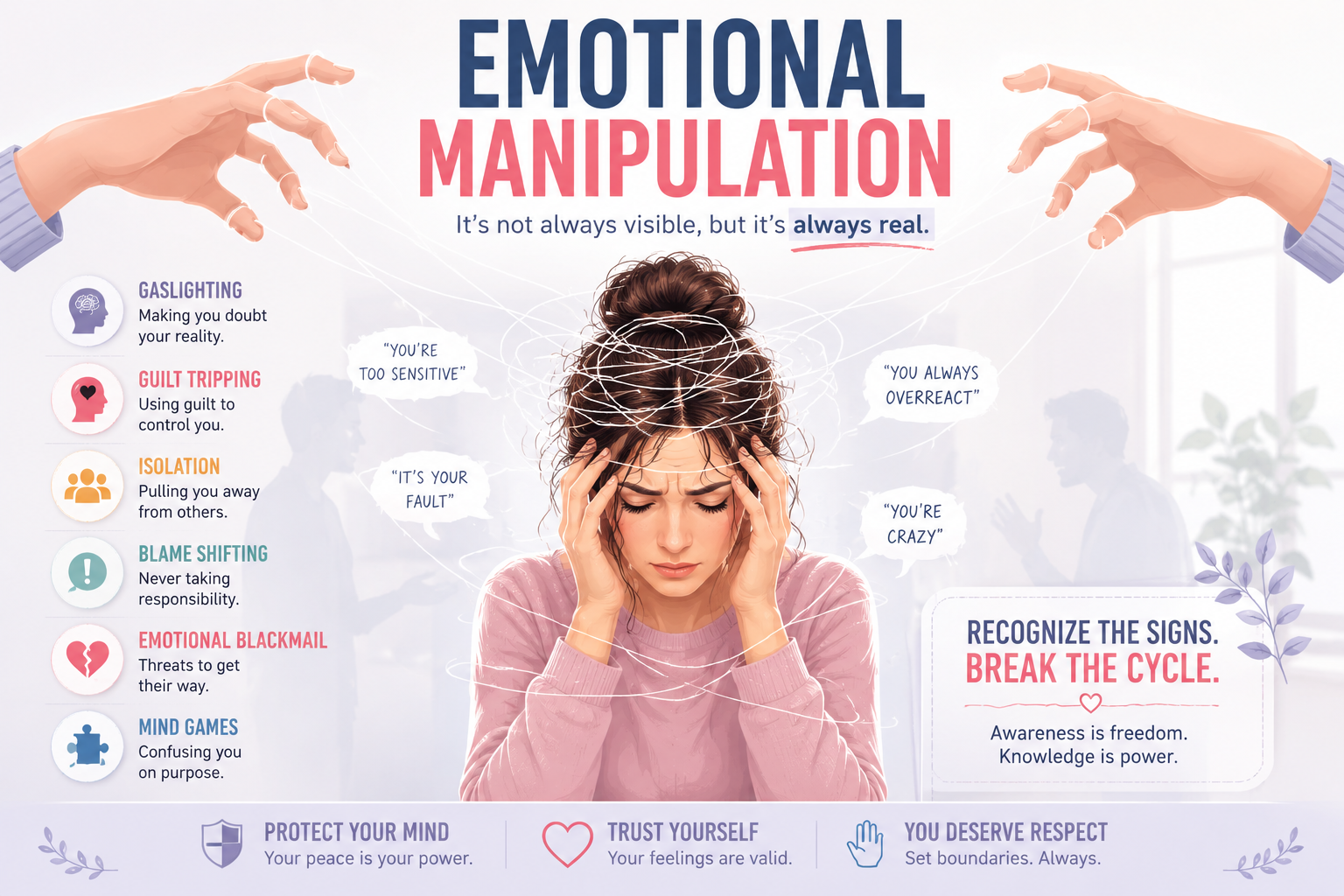
You feel confused after conversations that should have been simple. You apologize constantly but never quite know what you did wrong. You feel guilty for having needs. You feel like you are always the problem. You feel like you are losing your mind — your memory, your confidence, your sense of reality itself. You are not losing your mind. Someone is taking it. This is the complete, research-backed guide to recognizing emotional manipulation signs, understanding the psychology behind why it works so effectively, and — most importantly — how to break free from it.
| Updated: August 2026 | 20 Min Read | Psychology & Relationships | Fully Researched |

Emotional manipulation is not always dramatic. It rarely looks the way it does in movies. It is quiet, gradual, and designed specifically to make you doubt your own perceptions. By the time most people recognize the signs, they have already been significantly affected. Understanding the psychology is the first and most powerful step toward protecting yourself.
Let’s start with something that most articles about emotional manipulation signs don’t say clearly enough: emotional manipulation is not rare. It is not something that only happens in dramatic, obvious abusive relationships. It happens in ordinary friendships, in families, in workplaces, in romantic relationships that look perfectly normal from the outside. It happens slowly, incrementally, in ways that are almost impossible to see while you are inside them — because the entire architecture of manipulation is designed to prevent you from seeing it clearly.
The people most often targeted by emotional manipulators are not weak, naive, or stupid. Research consistently shows the opposite: people with high empathy, strong values, a genuine desire to do right by others, and a tendency toward self-reflection are significantly more vulnerable to emotional manipulation because these are exactly the qualities that manipulative tactics exploit. Your empathy is weaponized against you. Your desire to be fair is used to make you question yourself. Your self-reflection is turned into self-blame.
This article will not tell you to “just leave.” It will not dismiss the complexity of these situations or the very real reasons why leaving is often far more difficult than it sounds. What it will do is give you the specific knowledge — the signs, the psychology, the tactics, and the strategies — that you need to see what is actually happening clearly, and to make informed decisions from a place of understanding rather than confusion.
☰ TABLE OF CONTENTS
- What Is Emotional Manipulation? The Psychology Definition
- Why Emotional Manipulation Is So Hard to See
- The 12 Core Signs of Emotional Manipulation
- Gaslighting: When They Make You Question Your Own Reality
- The Reassurance-Seeking Trap Manipulators Create
- Media Control and Information Manipulation in Relationships
- Emotional Manipulation in Parenting and Family Dynamics
- Emotional Instability as a Manipulation Tool
- How Manipulators Use Habits, Routines, and Dependency
- The Role of Self-Esteem in Vulnerability to Manipulation
- Natural Remedies for the Trauma Manipulation Leaves Behind
- Atomic Habits for Breaking Free: Small Steps That Work
- How to Protect Your Mood and Mental State
- The Science-Backed Steps to Breaking Free
- Frequently Asked Questions
1. What Is Emotional Manipulation? The Psychology Definition That Changes Everything
Emotional manipulation is a pattern of behavior in which one person uses psychological tactics to control, influence, or exploit another person’s emotions, beliefs, or behavior — without the other person’s knowledge or genuine consent. The word “pattern” is important here. A single difficult conversation is not manipulation. A single moment of guilt-tripping is not necessarily manipulation. Manipulation is characterized by its sustained, systematic, and strategic nature — it is a relationship dynamic, not an isolated incident.
The key distinction that psychology makes between legitimate emotional influence and manipulation is the element of exploitation. We all influence each other’s emotions — that is simply what happens in human relationships. We share our feelings. We ask for things. We express disappointment. We try to persuade. These are normal, healthy parts of relating. Emotional manipulation crosses into exploitation when the tactics used bypass the other person’s rational agency — when they are designed to produce compliance not through honest communication but through confusion, fear, guilt, shame, or dependency.
Research in social psychology identifies emotional manipulation as a core feature of coercive control — a term now recognized in legal systems in multiple countries as a form of domestic abuse even in the absence of physical violence. The UK Domestic Abuse Act 2021 explicitly includes coercive and controlling behavior. The American Psychological Association’s research defines it as a pattern of behavior that “causes victims to feel fearful, enslaved, and unable to act freely.” What this tells us is that emotional manipulation is not a grey area. It is a documented, serious form of harm.
| 1 in 3 People experience emotional abuse in relationships |
7yr Average duration before leaving a manipulative relationship |
94% Of survivors say they doubted their own memory |
High Empathy = higher manipulation vulnerability |
2. Why Emotional Manipulation Is So Devastatingly Hard to See While You’re Inside It

The most common question people ask after recognizing emotional manipulation signs in a past relationship is: “How did I not see it?” The answer is not that you were blind or foolish. The answer is that emotional manipulation is specifically, architecturally designed to prevent you from seeing it — and it exploits neurological and psychological mechanisms that are features of healthy human relating, not bugs.
The Boiling Frog Effect: Emotional manipulation almost never begins at full intensity. It begins with small transgressions — a slightly unfair comment here, an unreasonable expectation there, a moment of guilt-tripping that feels strange but that you rationalize. Each individual incident is small enough to explain away. Over time, as the behavior escalates gradually, your baseline for what is normal shifts. What would have been obviously unacceptable at the beginning of the relationship becomes your new normal. By the time the manipulation is severe, you have no reference point for how severe it actually is.
Intermittent Reinforcement: This is the most psychologically powerful mechanism that sustains manipulative relationships. Research shows that unpredictable reward schedules — where positive experiences occur randomly and inconsistently — create stronger psychological attachment than consistent rewards. The manipulator is not always cruel. Sometimes they are wonderful — loving, kind, the person you fell in love with. The unpredictability of which version you will get creates a neurological bonding pattern that is actually stronger than what develops in consistently positive relationships. This is why the good times in a manipulative relationship feel so intensely good — and why the bond is so hard to break even when the bad times are genuinely terrible.
“The most dangerous aspect of emotional manipulation is not the harm it causes. It is that it prevents the target from accurately perceiving the harm. The weapon is invisibility.”
— Dr. Harriet Braiker, psychologist and author of Who’s Pulling Your Strings? How to Break the Cycle of Manipulation
3. The 12 Core Signs of Emotional Manipulation — Documented and Explained
These emotional manipulation signs are drawn from the research literature on coercive control, narcissistic personality dynamics, and psychological abuse. Read them carefully and honestly — not as a diagnosis of anyone specific, but as a framework for seeing patterns you may have normalized.
You constantly feel confused after conversations
You walk away from interactions feeling uncertain about what just happened — unclear about what was said, what was agreed, what was your fault. This confusion is often deliberately created. Manipulators use contradiction, misdirection, and word salad to leave you too disoriented to formulate a clear objection.
You apologize constantly — without knowing exactly what you did
When the environment has been structured so that you are always somehow at fault, you begin apologizing reflexively — as a conflict-resolution strategy, not because you genuinely believe you have done something wrong. This chronic apologizing reinforces your self-perception as the problem.
You feel guilty for having basic needs
Emotional manipulators systematically teach their targets that having needs is selfish, unreasonable, or burdensome. Over time, the target begins to preemptively suppress their needs before even expressing them — because experience has taught them that expressing needs causes conflict, disappointment, or punishment.
You question your own memory of events
This is the signature sign of gaslighting — a specific manipulation tactic in which the manipulator denies events occurred, insists your memory is wrong, or reframes events in ways that contradict your clear recollection. Over time, you begin to distrust your own perception and defer to theirs.
Your emotions are always characterized as excessive or irrational
When you express hurt, anger, or upset about something that has genuinely happened, the manipulator reframes your emotional response as the problem — you are “too sensitive,” “overreacting,” “crazy,” or “dramatic.” The actual behavior that caused your feeling is never addressed because the conversation has been redirected to your reaction.
You feel responsible for managing their emotional state
You find yourself constantly monitoring their mood, adjusting your behavior to prevent them from becoming upset, and feeling responsible when they are unhappy — regardless of whether their unhappiness has anything to do with you. This emotional labor becomes all-consuming and is a form of control that keeps you focused on them rather than yourself.
You have become increasingly isolated from other relationships
Isolation is a primary tool of manipulation because it removes external perspectives that might allow the target to calibrate their sense of what is normal. It may happen directly — through criticism of friends and family — or indirectly — through demanding so much of your time and emotional energy that other relationships naturally wither.
Conflict always ends with you feeling worse and them feeling better
In healthy conflict, both parties feel some discomfort and both work toward resolution. In manipulative dynamics, conflict consistently ends with the target feeling like the problem, apologizing, and working to comfort the manipulator — regardless of what the conflict was originally about or who triggered it.
You feel like you are walking on eggshells
The chronic hypervigilance of monitoring another person’s moods, anticipating their reactions, and preemptively adjusting your behavior to prevent their displeasure is one of the most recognized features of living in a manipulative relationship. It keeps you in a permanent state of low-grade anxiety that becomes normalized as simply “how this relationship is.”
Your self-esteem has declined significantly since the relationship began
One of the most reliable indicators of emotional manipulation is a measurable decline in self-worth over the course of a relationship. If you were more confident, more self-assured, and had a clearer sense of your own worth before this relationship than you do now — that is not personal growth. That is damage.
You feel a constant low-level exhaustion you can’t explain
The emotional labor of managing a manipulative relationship — the constant hypervigilance, the emotional suppression, the cognitive work of trying to make sense of situations that have been deliberately made confusing — is metabolically and neurologically exhausting in ways that accumulate invisibly over time.
People outside the relationship seem more alarmed than you feel
When friends, family members, or therapists express concern about your relationship and their concern seems disproportionate to how you feel — this is a significant signal. Normalization happens from the inside out. People outside the dynamic see it more clearly than you can from within it.
4. Gaslighting: When They Make You Doubt Your Own Reality
Gaslighting — named after the 1944 film Gaslight in which a husband manipulates his wife into doubting her sanity — is the most psychologically devastating form of emotional manipulation because it targets the victim’s relationship with their own perception of reality. When you can no longer trust your own memory and experience, you become entirely dependent on the manipulator’s version of events.
Gaslighting is the most sophisticated and most devastating form of emotional manipulation. It works by systematically undermining the target’s trust in their own perception, memory, and judgment — creating a state of psychological dependency in which the target cannot function without the manipulator’s version of reality to orient themselves.
Gaslighting tactics include: flatly denying that something occurred that you clearly remember; insisting that your memory of an event is wrong despite your certainty; telling you that you said or did things you have no memory of; enlisting others to confirm their version of events (triangulation); progressively convincing you that your perception of reality is a symptom of mental illness; and using your reasonable emotional responses to their behavior as evidence that you are unstable.
The long-term effects of sustained gaslighting are severe and well-documented. Survivors report profound self-doubt, difficulty making decisions, a persistent sense that their perceptions cannot be trusted, and in severe cases symptoms indistinguishable from dissociation and trauma. The most powerful antidote to gaslighting is external validation and documentation — keeping a private journal, confiding in trusted people outside the relationship, and anchoring your memory in records that cannot be revised.
5. The Reassurance-Seeking Trap That Emotional Manipulators Create

One of the most insidious long-term effects of sustained emotional manipulation is the development of compulsive reassurance-seeking — a pattern in which the target becomes chronically unable to trust their own judgment and constantly seeks confirmation and validation from others. This often looks like anxiety or OCD from the outside, and it frequently gets diagnosed as such without the underlying manipulation being identified.
When someone has been consistently told that their perceptions are wrong, their memories are unreliable, and their emotional responses are excessive, they lose the internal anchor that allows most people to function with reasonable confidence in their own judgment. The result is a person who needs constant external confirmation — from the manipulator, from other relationships, from therapists — before they can commit to any perception or decision.
Research on coercive control identifies this reassurance dependency as a deliberate outcome of manipulation rather than a coincidental one. By making the target dependent on external validation, the manipulator has created a system in which the target cannot function autonomously — which keeps them in the relationship even when they know something is wrong, because leaving requires a level of confidence in their own judgment that the manipulation has systematically eroded.
6. Information Control: How Manipulators Use Noam Chomsky’s Media Strategies in Relationships

Noam Chomsky identified 10 strategies used by media and institutions to control public thought — including distraction, gradual escalation, manufactured consent, and emotional exploitation. These same strategies appear in personal manipulation dynamics, operating at the interpersonal rather than the societal level.
Noam Chomsky’s famous analysis of media manipulation strategies — which include distraction, gradual escalation, manufacturing consent, dumbing down, and exploiting emotions over reason — has a direct parallel in interpersonal manipulation dynamics. Manipulators in personal relationships use the same structural strategies that propaganda and media control use at the societal level, applied to the microcosm of a personal relationship.
Distraction: Creating enough drama, crisis, and urgent problems that the target never has the mental space to step back and evaluate the relationship clearly. Gradual escalation: The behavior becomes more extreme slowly enough that each individual step seems manageable. Manufactured consent: Framing the target’s compliance as voluntary choice — “you agreed to this” — when the agreement was produced through pressure, guilt, or exhaustion rather than genuine free choice. Emotional exploitation: Bypassing rational evaluation by keeping the target in an emotionally heightened state where clear thinking is neurologically impaired.
Understanding that the tactics used against you are not uniquely personal — that they follow documented patterns used by manipulators across different contexts and cultures — is both validating and empowering. The manipulation did not work because you were particularly foolish. It worked because it followed a playbook that is specifically designed to work on intelligent, empathetic people.
7. Emotional Manipulation in Family Dynamics: The Hardest Kind to See

Family-based emotional manipulation signs are perhaps the most difficult to recognize because the relationship context — parent-child, sibling-sibling — provides ready explanations and justifications for behaviors that would be immediately recognizable as manipulation in other contexts. Love, obligation, loyalty, and the sheer fact that these are people who knew you before you could evaluate them critically create powerful shields around family manipulation.
Parental emotional manipulation often operates through guilt as a primary currency — “after everything I’ve done for you,” “I gave up so much for you,” “you have no idea how much you hurt me.” It operates through conditional love — approval that is given and withdrawn based on the child’s compliance rather than on anything intrinsic to their worth. It operates through enmeshment — the erasure of appropriate boundaries between parent and child so that the child becomes responsible for the parent’s emotional state.
Adults who grew up in emotionally manipulative family systems often carry deeply embedded patterns of self-blame, people-pleasing, and difficulty trusting their own perceptions that make them more vulnerable to manipulation in adult relationships. Recognizing family-origin manipulation is not about blame — parents who manipulate often do so from their own unhealed wounds rather than from malice. But recognizing it is essential to understanding your own patterns and changing them.
8. Emotional Instability as a Manipulation Tool: The Unpredictability Weapon

Emotional volatility — extreme and unpredictable mood swings, explosive anger, sudden withdrawal, dramatic shifts between warmth and coldness — is one of the most effective emotional manipulation tools, whether consciously deployed or not. The unpredictability itself is the mechanism of control.
When a person’s emotional state is unpredictable, those around them enter a permanent state of hypervigilance — continuously monitoring mood cues, adjusting behavior to avoid triggering negative responses, and operating in a chronic state of anxiety. This hypervigilance is exhausting and it is controlling. The target’s entire behavioral range is effectively managed by the manipulator’s emotional volatility without the manipulator needing to issue any explicit demands.
The research on intermittent reinforcement is directly relevant here. The alternation between warmth and coldness, approval and withdrawal, closeness and punishment creates exactly the neurological bonding pattern that makes leaving feel impossible. The good periods are not evidence that the relationship is fundamentally healthy. They are part of the same cycle that makes it toxic.
9. How Manipulators Use Habits and Routines to Build Dependency
Manipulative relationships build habitual patterns — routines of checking in, seeking approval, apologizing, and managing the other person’s emotions — that become as automatic as any other habit. James Clear’s atomic habits framework explains how these patterns form and, crucially, how they can be systematically dismantled through small, deliberate changes.
One of the underappreciated dimensions of emotional manipulation is how it works through habit formation. Over time, the target develops automatic, habitual patterns of behavior in relation to the manipulator — checking in constantly, seeking approval before making any decision, suppressing opinions before expressing them, apologizing preemptively — that run automatically without conscious awareness. These habits are maintained by the reward and punishment patterns the manipulation creates.
James Clear’s research on habit formation in Atomic Habits describes the habit loop: cue — routine — reward. In manipulative relationships, the cue is the manipulator’s mood signal or demand, the routine is the target’s appeasement behavior, and the reward is a temporary reduction in tension or conflict. This loop runs thousands of times over the course of a relationship until the appeasement behavior is as automatic as brushing your teeth. Breaking free requires not just the decision to leave or change, but the deliberate dismantling of these ingrained behavioral patterns — which takes time, intention, and often professional support.
10. Self-Esteem: The Target Manipulators Always Aim For First

Self-esteem is the primary target of emotional manipulation because it is the foundation that all other psychological independence rests on. A person with robust self-esteem is significantly harder to manipulate: they trust their own perceptions, they believe they deserve fair treatment, and they have the inner resources to leave situations that do not honor their worth. Manipulators — consciously or not — understand this, and their tactics systematically erode the target’s self-esteem from the earliest stages of the relationship.
The erosion happens through many channels: subtle criticism disguised as “just being honest,” comparisons to others that consistently find the target lacking, withdrawal of approval when the target does not perform to expectation, reframing the target’s legitimate achievements as less impressive than they are, and the chronic message — conveyed in a thousand small ways — that the target should be grateful for the relationship rather than expecting to be treated well within it.
The research on self-esteem and resilience to manipulation is clear: rebuilding self-esteem is not vanity — it is the foundational psychological repair that makes everything else in recovery possible. You cannot set limits from a place of worthlessness. You cannot leave a situation you believe you deserve. Rebuilding your self-esteem is not optional in recovery from emotional manipulation. It is the recovery.
11. Supporting Recovery: Natural and Complementary Approaches to Healing Manipulation Trauma

Recovery from emotional manipulation involves healing a nervous system that has been in a state of chronic stress and hypervigilance. Alongside professional therapy and the psychological work of recovery, there are evidence-supported complementary approaches that can support the physiological healing process — particularly the regulation of the stress response and the restoration of neurochemical balance.
Ashwagandha (Withania somnifera) has the strongest evidence base among adaptogenic herbs for reducing cortisol levels and anxiety symptoms. A 2019 randomized controlled trial found that 240mg of ashwagandha extract daily significantly reduced stress, anxiety, and morning cortisol levels compared to placebo. Rhodiola rosea has research support for reducing fatigue and improving stress resilience, particularly relevant for the exhaustion that follows sustained manipulative relationships.
Body-based practices are particularly important in manipulation trauma recovery because, as trauma researcher Bessel van der Kolk documented in The Body Keeps the Score, trauma is stored in the body as well as the mind. Yoga, somatic experiencing, EMDR therapy, and regular aerobic exercise all have research support for trauma recovery. These are not alternatives to professional therapy. They are powerful supplements to it — addressing the physiological dimension of a healing process that has both psychological and physical components.
12. Atomic Habits for Breaking Free: The Small Daily Steps That Actually Work
Breaking free from emotional manipulation is not a single dramatic decision. It is a series of small, daily choices that, accumulated over time, rebuild the psychological foundation that manipulation eroded. James Clear’s research on atomic habits is directly applicable here: the most reliable path to lasting behavioral change is not massive willpower efforts but small, consistent improvements of 1% per day.
■ DAILY ATOMIC HABITS FOR RECOVERING FROM EMOTIONAL MANIPULATION
► Keep a private journal — 5 minutes daily. Record what happened, how you felt, what you noticed. This rebuilds your trust in your own perception and creates a record that cannot be revised
► Name one true thing about yourself daily — Not achievements. One genuine quality you actually have. This builds the habit of self-recognition that manipulation has suppressed
► Practice one small self-honoring choice daily — Choose what you want to eat, what you want to watch, what you want to think about. Rebuilding autonomous preference is a skill that needs deliberate practice
► Spend 15 minutes weekly with someone who knew you before — Relationships that predate the manipulation contain a mirror of who you were and who you can be again
► Identify and name one manipulative tactic when you notice it — Simply naming what is happening — “that was gaslighting” — begins to break the spell of confusion
► Delay your apology by 24 hours — Before apologizing, ask: did I actually do something wrong? The pause creates space for genuine evaluation rather than reflexive appeasement
► 10-minute daily walk in nature — Regulates the nervous system, breaks rumination cycles, and provides the quiet space the manipulated mind desperately needs
13. Protecting Your Mood and Mental State During and After Manipulation

When you are in or recovering from an emotionally manipulative relationship, your mood and mental state are in a genuinely vulnerable condition. The chronic stress of manipulation has altered your neurochemistry — depleting dopamine and serotonin, dysregulating cortisol, and keeping your amygdala in a state of persistent hyperactivation. Protecting and restoring your mental state is not self-indulgence. It is a medical necessity.
Limit information exposure from the manipulator. Every contact with someone who is actively manipulating you sends another wave of cortisol through your system and reopens the cognitive confusion they have cultivated. Where possible, information exchanges should be minimal, structured, and limited to factual content. Protect sleep ruthlessly. The neurochemical restoration that sleep provides is critical to clear thinking, emotional regulation, and the ability to perceive reality accurately — all of which manipulation has degraded.
Create predictability and routine in areas you control. After the chronic unpredictability of a manipulative relationship, your nervous system needs to experience that the world can be safe, stable, and reliable. Simple, consistent daily routines — consistent meals, sleep times, exercise — are neurologically grounding in ways that are not fully appreciated until you experience their absence.
14. The Science-Backed Steps to Breaking Free From Emotional Manipulation

Exhaustion is one of the most common legacies of emotional manipulation. The chronic effort of managing an unpredictable, manipulative relationship depletes energy reserves in ways that take months to replenish. Recovery is not immediate — it is a process. But every small step toward clarity, authenticity, and self-trust is a step in a direction that leads out of the fog.
Breaking free from emotional manipulation is not a single moment. It is a process. These steps, drawn from the clinical and research literature on recovery from coercive control, provide a framework for that process — not as a rigid sequence but as a set of parallel, mutually reinforcing movements toward freedom.
① Name What Is Happening — Without Minimizing It
The single most powerful first step is to name what is happening clearly — not in the mitigated, minimized language that manipulation teaches you to use, but in direct terms: “This is manipulation. This is not okay. This is not my fault.” Naming removes the cognitive fog that manipulation depends on for its continued function.
② Rebuild External Reality Checks
Re-engage with people who knew you before, with a therapist, with trusted friends who can provide a perspective on your situation that is not filtered through the manipulator’s narrative. Isolation is part of what keeps manipulation functioning. Rebuilding genuine connections is both a symptom of recovery and a mechanism of it.
③ Seek Trauma-Informed Professional Support
Therapists trained in coercive control and trauma have specific skills for helping people recover from the particular kind of damage emotional manipulation causes. EMDR, trauma-focused CBT, and somatic therapies all have evidence bases for this population. A general therapist without this training may inadvertently reinforce patterns of self-blame if they are not familiar with the specific dynamics of manipulative relationships.
④ Rebuild Your Self-Concept From the Inside Out
This is the longest and most important part of recovery. Rebuilding your self-concept means systematically replacing the manipulator’s version of who you are — built through years of criticism, comparison, and diminishment — with an accurate, self-generated understanding of your own value, capabilities, and worth. This takes time. It takes consistency. It takes being in relationships where you are genuinely seen and valued. And it is entirely possible.
“You did not fall in love with someone who treated you badly. You fell in love with someone who then began to treat you badly — gradually, incrementally, in ways designed to prevent you from seeing what was happening. That is not your failure. That is their method.”
— Dr. Lundy Bancroft, psychologist and author of Why Does He Do That? Inside the Minds of Angry and Controlling Men
15. Frequently Asked Questions About Emotional Manipulation Signs
❓ What are the main signs of emotional manipulation?
The main signs of emotional manipulation include: feeling confused after conversations that should have been simple; constant apologizing without knowing clearly what you did wrong; feeling guilty for having basic needs; doubting your own memory of events; your emotions being dismissed as excessive or irrational; feeling responsible for managing the other person’s emotional state; gradual isolation from other relationships; conflict consistently ending with you feeling worse and them feeling better; chronic walking on eggshells; a measurable decline in self-esteem since the relationship began; persistent unexplained exhaustion; and people outside the relationship expressing alarm that seems disproportionate to how you currently perceive the situation.
❓ What is gaslighting and how do I know if it’s happening to me?
Gaslighting is a specific emotional manipulation tactic in which someone systematically causes you to doubt your own perception, memory, and judgment. Signs that gaslighting is happening to you include: someone repeatedly denying that events occurred that you clearly remember; being told your memory of specific conversations or incidents is consistently wrong; finding yourself apologizing for things you don’t believe you actually did; beginning to defer to someone else’s account of reality rather than your own; losing confidence in your own perceptions over time; and being told by others that your reactions to situations seem appropriately proportional, even when the person being discussed says you are overreacting. Keeping a private journal of events is one of the most effective tools for maintaining your grip on reality when experiencing gaslighting.
❓ Why is emotional manipulation so hard to leave?
Emotional manipulation is hard to leave for several documented psychological reasons. Intermittent reinforcement — the unpredictable alternation between positive and negative treatment — creates neurological bonding patterns that are actually stronger than those formed in consistently positive relationships, explaining why the good times feel so intense and why the bond is so hard to break. Additionally, manipulation systematically erodes the self-esteem and trust in one’s own judgment that would be needed to leave with confidence. The gradual normalization of the behavior means there is no clear moment of recognition — only a slow shift that is hard to perceive from inside. Isolation from external perspectives removes people who might otherwise provide reality checks. And practical, financial, and logistical dependencies are often deliberately cultivated as additional barriers to leaving.
❓ Can emotional manipulation happen in friendships and families, not just romantic relationships?
Yes, absolutely. Emotional manipulation occurs across all relationship types — romantic partnerships, friendships, family relationships (particularly parent-child and sibling dynamics), and workplace relationships. Family-based emotional manipulation is often the most difficult to recognize because the relationship context provides built-in justifications for behaviors that would be immediately recognized as manipulation in other settings. The tactics are the same regardless of relationship type: guilt, gaslighting, conditional love or approval, isolation, and intermittent reinforcement. Family-origin emotional manipulation is particularly significant because it shapes the psychological patterns that determine vulnerability to manipulation in adult relationships.
❓ How do I recover from emotional manipulation?
Recovery from emotional manipulation is a process rather than a single event and typically involves several parallel streams of work. The most important is trauma-informed professional therapy — particularly approaches like EMDR, trauma-focused CBT, or somatic experiencing that address both the psychological and physiological dimensions of the harm. Rebuilding social connections with people who knew you before provides external perspective and validation. Keeping a private journal rebuilds trust in your own perception. Regular aerobic exercise and sleep hygiene support the neurochemical restoration that is part of healing. Gradually rebuilding self-esteem through self-honoring choices, clear values, and relationships that genuinely see and value you is the foundational work that everything else supports. Recovery timelines vary widely depending on the severity and duration of the manipulation, but genuine recovery is possible and is not extraordinary — it is what consistently happens when people get appropriate support.
❓ Are emotional manipulators always aware of what they’re doing?
Not always. Emotional manipulation exists on a spectrum of intentionality. Some manipulators are fully conscious of the tactics they use and deploy them deliberately and strategically. Others have deeply ingrained patterns of behavior — often learned in their own families of origin or developed as coping strategies for their own psychological wounds — that produce manipulative outcomes without any conscious intent. Both cause the same harm to the target. Understanding whether manipulation is conscious or unconscious can provide context, but it does not change the impact on the person experiencing it, and it does not create an obligation on the target to remain in the relationship. The question of intentionality matters for understanding the person causing harm. It does not determine whether what is happening to you is real, serious, and deserving of a response.
A Final Note — For Anyone Who Needed This Article
If you found this article because something in your life felt wrong in a way you could not quite name — if you have been explaining away a consistent pattern of confusion, self-doubt, and diminishment — please trust what brought you here. That sense that something is not right is important information. It deserves to be taken seriously. You deserve to take it seriously.
The confusion you feel is not evidence that you are confused by nature. It is evidence of what has been done to your clarity. The self-doubt you carry is not evidence that you should be doubted. It is evidence of what sustained manipulation does to self-trust. These things are reversible. Your clarity can come back. Your self-trust can come back. Your life can become yours again.
If you are in immediate danger or in crisis, please reach out to a domestic abuse helpline. In the US: National Domestic Violence Hotline — 1-800-799-7233. In the UK: National Domestic Abuse Helpline — 0808 2000 247. Both are free, confidential, and available 24 hours.
▪ RELATED MENTAL HEALTH & PSYCHOLOGY ARTICLES
→ The Physical Symptoms of Anxiety Your Body Is Sending You
→ You’re Not Lazy. You’re Mentally Exhausted: The Complete Burnout Guide
→ High-Functioning Anxiety: When You Look Fine But Feel Anything But
→ Narcissistic Personality Disorder: The Complete Psychology Guide
→ How to Set Healthy Boundaries Without Guilt: The Research-Backed Guide
▤ SOURCES & RESEARCH
▸ Bancroft, L. — Why Does He Do That? Inside the Minds of Angry and Controlling Men (Berkley Books, 2002)
▸ Braiker, H. — Who’s Pulling Your Strings? How to Break the Cycle of Manipulation (McGraw-Hill, 2004)
▸ van der Kolk, B. — The Body Keeps the Score: Brain, Mind, and Body in the Healing of Trauma (Viking, 2014)
▸ Clear, J. — Atomic Habits: An Easy and Proven Way to Build Good Habits and Break Bad Ones (Avery, 2018)
▸ Chomsky, N. — Manufacturing Consent: The Political Economy of the Mass Media (Pantheon, 1988)
▸ UK Domestic Abuse Act 2021 — Coercive and Controlling Behaviour Provisions
▸ American Psychological Association — Coercive Control Research Resource Library — apa.org