Table of Contents
- What Is This Ancient Plague Discovery?
- How Scientists Found 5,500-Year-Old Plague DNA
- Why This Discovery Changes Everything We Knew
- The Hunter-Gatherers of Lake Baikal
- How the Ancient Plague Spread Between Humans
- The Connection Between Ancient and Modern Plague
- What This Means for Understanding Pandemics
- Timeline: The Complete History of Plague
- FAQs About the Ancient Plague Discovery
What Is This Ancient Plague Discovery?
Here’s something that will completely blow your mind. Scientists just announced in June 2026 that they’ve found the oldest evidence of plague ever recorded in human history, and it’s way older than anyone expected.
We’re talking about an ancient plague discovery that pushes back the timeline of this devastating disease by at least 200 years. The deadly bacterium Yersinia pestis, the same bug responsible for the Black Death that wiped out half of Europe, was lurking in Siberian hunter-gatherer communities 5,500 years ago.
This isn’t some minor footnote in history books. This discovery, published in the prestigious journal Nature on June 17, 2026, fundamentally changes our understanding of how plague evolved, how it spread, and who it affected first.
For decades, scientists believed that plague became a serious threat only after humans settled down into agricultural communities. The theory made sense on paper: farming attracted rats, rats carried fleas, fleas spread plague. Simple cause and effect.
But these Siberian hunter-gatherers weren’t farmers. They were nomads. And they were dying from plague in devastating family-wide outbreaks thousands of years before the first known agricultural plague cases.
How Scientists Found 5,500-Year-Old Plague DNA
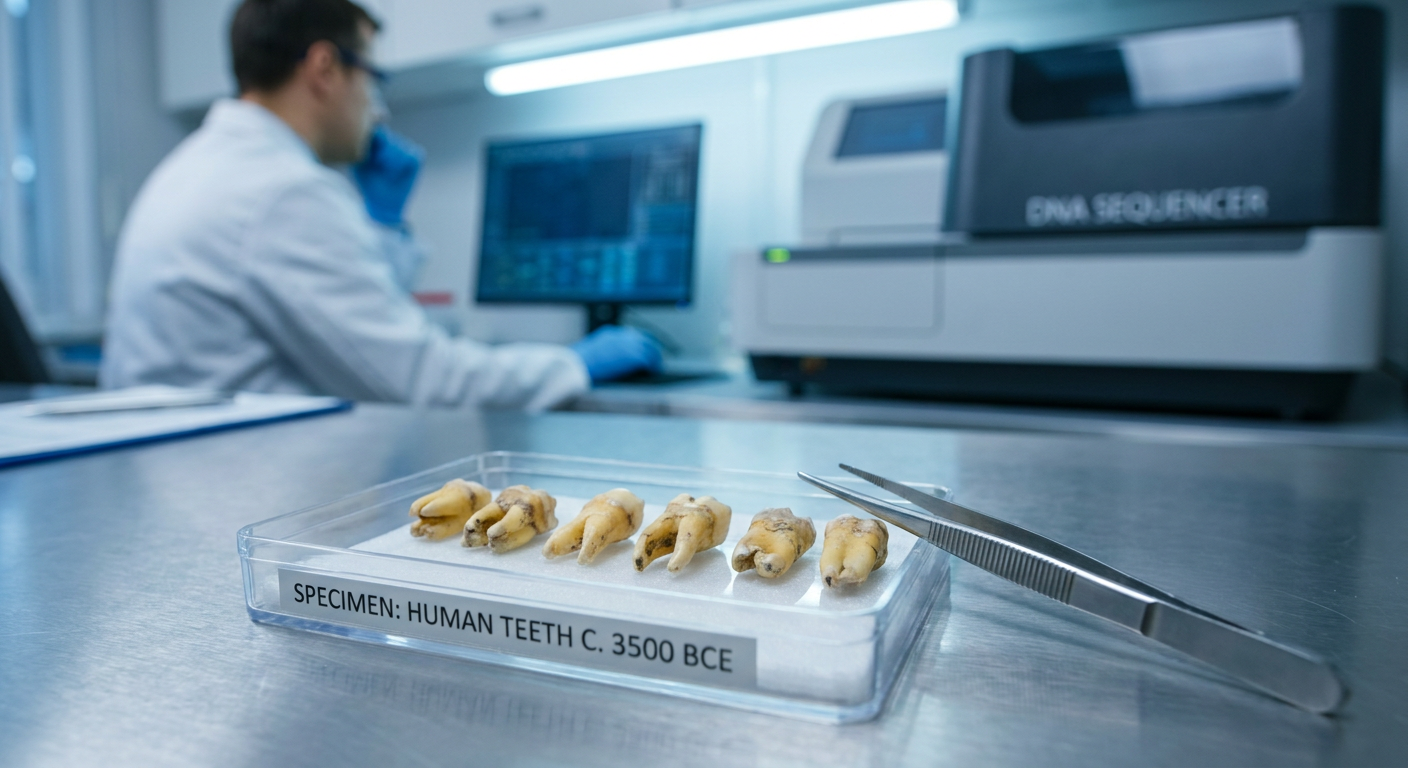
The research team, led by evolutionary geneticist Eske Willerslev from the University of Copenhagen, didn’t just stumble onto this ancient plague discovery by accident. It took years of painstaking work extracting and analyzing ancient DNA from teeth buried for millennia.
The Teeth Tell the Story
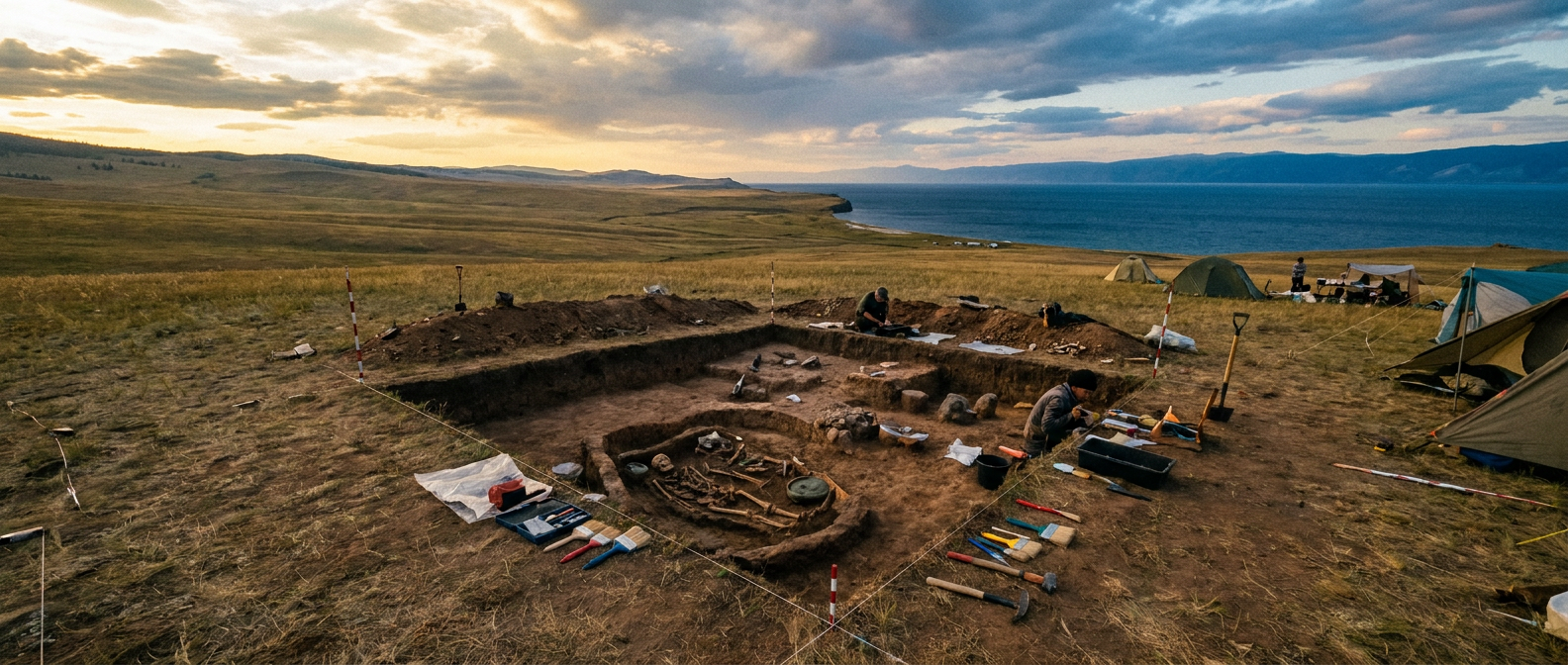
Here’s how they did it. The team examined skeletal remains from four separate hunter-gatherer cemeteries near Lake Baikal in southeast Siberia. They focused on teeth because dental pulp is one of the best-preserved sources of ancient DNA.
What they found was staggering: a 39% detection rate for plague infection across the remains they tested. Let that number sink in. Nearly 4 out of every 10 people buried in these cemeteries had Yersinia pestis in their systems when they died.
Two Distinct Outbreak Phases
The ancient plague discovery revealed not just one, but two separate phases of outbreaks. This tells us that plague didn’t strike once and disappear. It came back. It persisted. It was a recurring nightmare for these communities.
The researchers reconstructed complete kinship pedigrees (essentially family trees) using the DNA. This allowed them to prove that entire family groups were being affected, which is consistent with human-to-human transmission of the disease.
The Technology Behind the Discovery
Modern ancient DNA (aDNA) technology has come incredibly far. The team used:
- Next-generation sequencing to reconstruct complete plague genomes
- Kinship analysis to map family relationships
- Radiocarbon dating to establish precise timelines
- Comparative genomics to trace plague evolution
This combination of technologies made it possible to not just detect the plague, but understand how it moved through communities 5,500 years ago.
Why This Discovery Changes Everything We Knew
Let me be real with you. This ancient plague discovery doesn’t just add a new chapter to the history books. It rips out several chapters and demands a complete rewrite.
Myth Busted: Plague Needed Agriculture
The biggest bombshell? The long-standing theory that plague only became dangerous when humans started farming is now essentially dead.
Scientists previously believed that:
- Agriculture created permanent settlements
- Permanent settlements attracted rodents
- Rodents brought plague-carrying fleas
- Dense populations allowed plague to spread
But these Lake Baikal communities were hunter-gatherers. They moved around. They lived in small groups. According to the old theory, plague shouldn’t have been able to cause significant outbreaks among them.
Yet here we are, with hard evidence that it absolutely did.
Earlier Than Anyone Thought
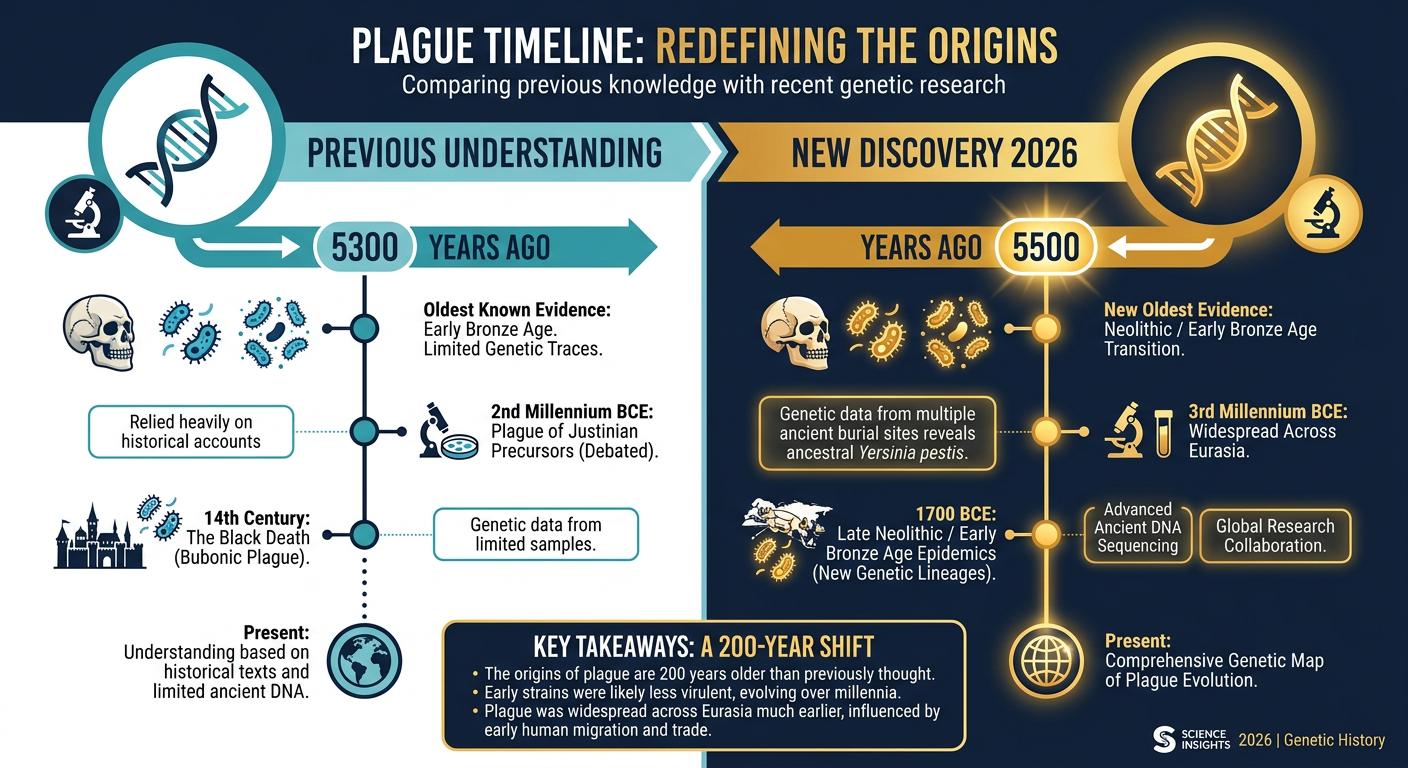
Before this ancient plague discovery, the oldest confirmed plague cases dated to about 5,300 years ago. This new research pushes that timeline back by roughly 200 years to 5,500 years ago.
That might not sound like much, but in archaeological terms, 200 years is enormous. It means plague was circulating in human populations during the mid-Holocene period, a time we previously associated with relative health and expansion of human communities.
Human-to-Human Transmission Was Already Happening
Perhaps the most unsettling finding is that these early plague strains were already spreading directly between humans. The family-cluster pattern of infections proves it.
This challenges another assumption: that early plague could only spread through animal vectors (like flea bites). The evidence now shows that pneumonic transmission (through respiratory droplets) or direct contact was occurring 5,500 years ago.
The Hunter-Gatherers of Lake Baikal

To understand this ancient plague discovery in context, you need to know about the people who suffered through it.
Who Were They?
The mid-Holocene hunter-gatherers of Lake Baikal were not primitive people living hand-to-mouth. They were sophisticated communities with:
- Complex burial practices (evidenced by the organized cemeteries)
- Social hierarchies (shown through burial goods and placement)
- Trade networks (demonstrated by materials from distant regions)
- Strong family bonds (revealed by the kinship patterns in burial sites)
Their Way of Life
Lake Baikal, the world’s deepest freshwater lake, provided an incredibly rich environment. These communities survived by:
- Fishing the abundant waters of Lake Baikal
- Hunting large game across the Siberian steppe
- Gathering seasonal plants and berries
- Following animal migration patterns
They weren’t desperate survivalists. They were thriving. And then plague struck.
The Impact on Their Communities
The 39% infection rate tells a devastating story. Imagine your family, your close-knit community of perhaps 20-30 people, and nearly half of them falling ill with a disease that had no cure, no treatment, and no explanation.
The cemetery evidence shows that entire family units died together, sometimes within short periods. Parents and children. Siblings. Extended family groups wiped out in a single outbreak.
How the Ancient Plague Spread Between Humans
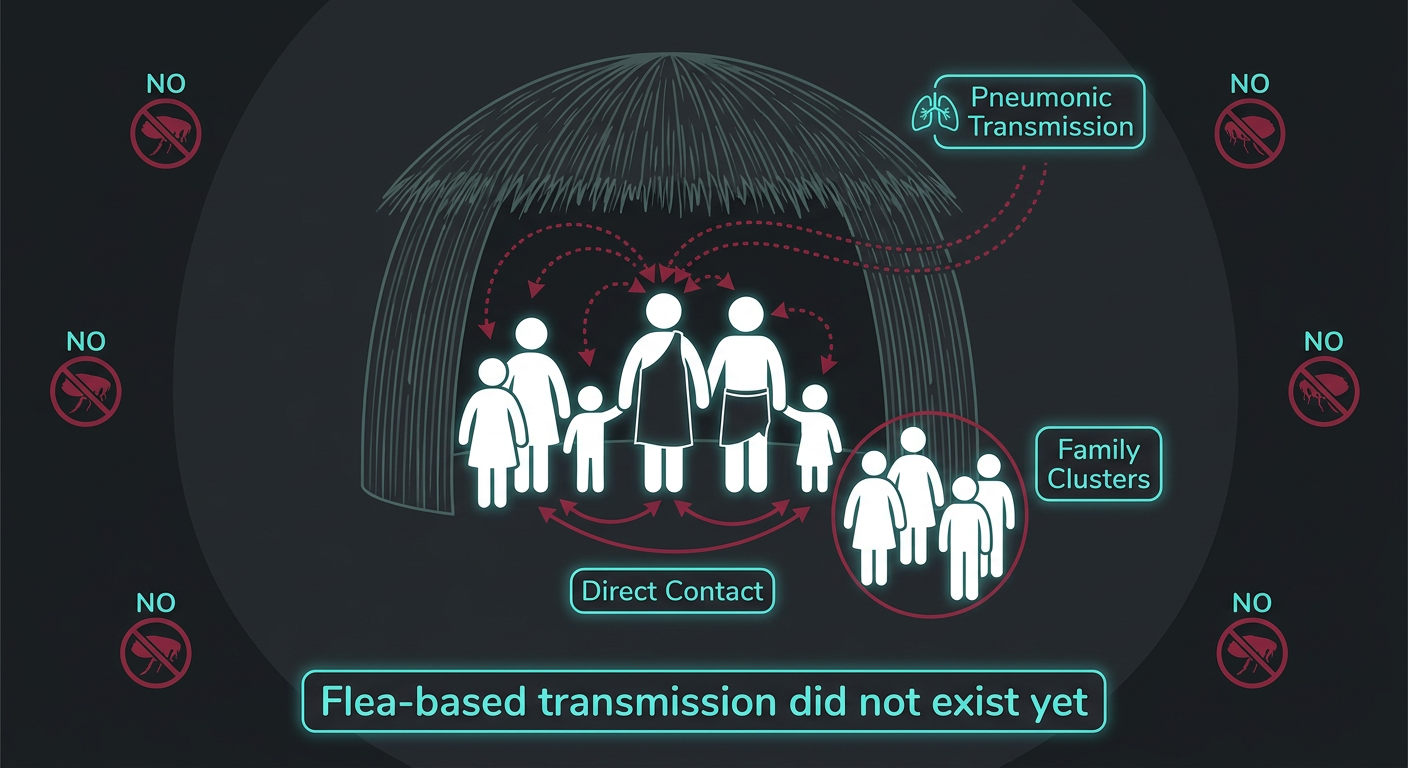
One of the most significant aspects of this ancient plague discovery is what it reveals about how plague moved from person to person in these early communities.
The Family Cluster Evidence
By mapping family relationships through DNA, the researchers proved that plague infections clustered within small familial groups. This pattern is the smoking gun for human-to-human transmission.
If plague were spreading only through animal vectors (like infected fleas from rodents), you’d expect a more random distribution of cases. Instead, the pattern shows clear chains of transmission within families.
What Form Did It Take?
Modern plague comes in three forms:
- Bubonic plague (spread by flea bites, causes swollen lymph nodes)
- Pneumonic plague (spread through respiratory droplets, attacks the lungs)
- Septicemic plague (enters the bloodstream directly)
Here’s the interesting wrinkle: these 5,500-year-old strains lacked the virulence factors needed for bubonic transmission. The molecular machinery for flea-mediated spread didn’t evolve until about 3,800 years ago.
So how was it spreading? The most likely answer is pneumonic transmission, a terrifying form of plague that spreads through coughs, sneezes, and close contact. This form is also the most lethal, with near-100% mortality if untreated.
Small Groups, Big Impact
You might think that small, mobile groups would be somewhat protected from epidemic disease. In many cases, that’s true. But pneumonic plague is different.
It’s so rapidly fatal and so highly contagious in close quarters that even a small family group sleeping in the same shelter could experience complete devastation within days. The hunter-gatherer lifestyle, with its intimate family groups sharing close living spaces, may have actually made them more vulnerable to this particular form of transmission.
The Connection Between Ancient and Modern Plague
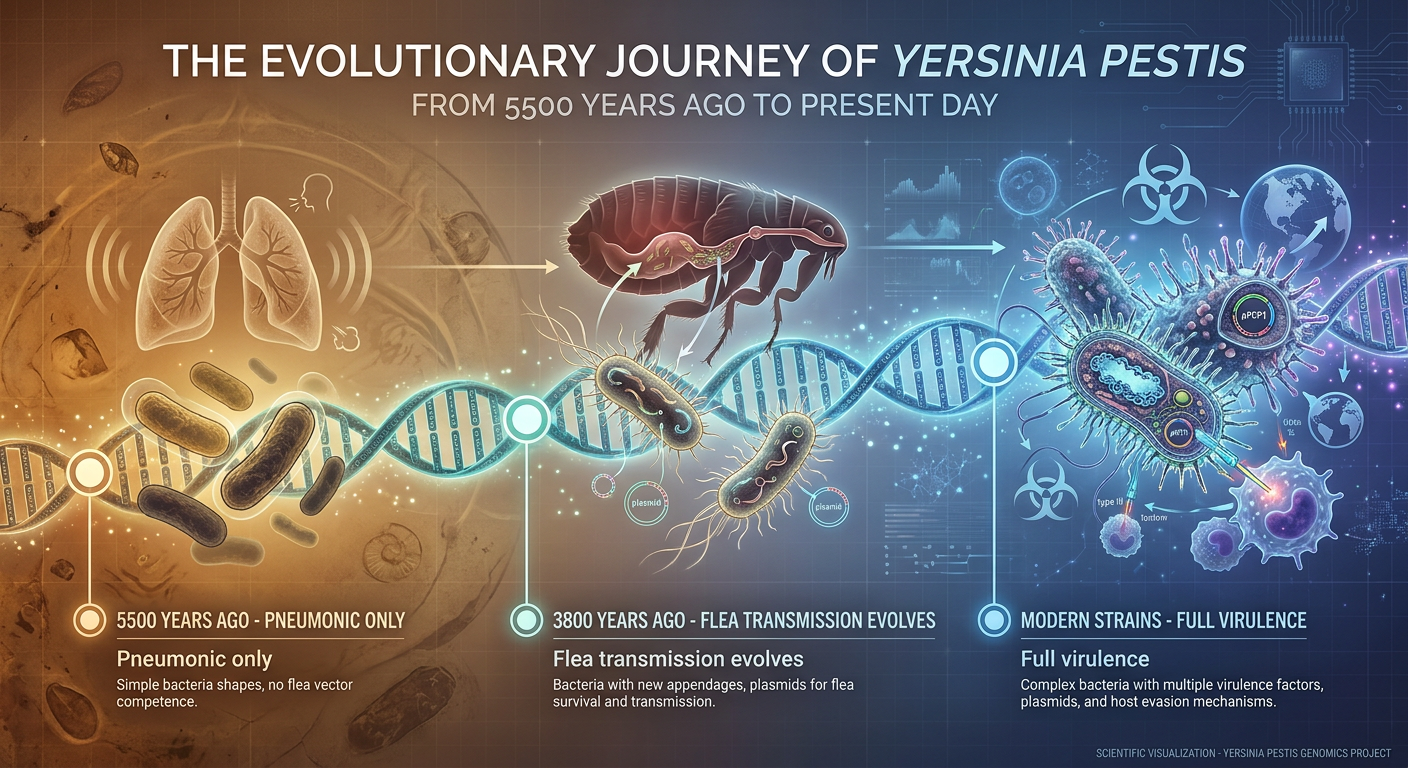
This ancient plague discovery doesn’t exist in isolation. It connects directly to the plague we know today.
Same Bacterium, Different Weapons
The Yersinia pestis found in these 5,500-year-old remains is recognizably the same organism that caused:
- The Plague of Justinian (541-549 AD) killing 25-50 million people
- The Black Death (1346-1353) killing 75-200 million people
- The Third Pandemic (1855-1960) killing 12-15 million people
But the ancient version was different in crucial ways. It hadn’t yet evolved the genetic tools for flea-based transmission. It was essentially a more “primitive” version of the pathogen, relying on direct human contact rather than insect vectors.
The Evolutionary Journey
Between 5,500 years ago and 3,800 years ago, Yersinia pestis evolved the ability to:
- Survive in flea guts
- Block the flea’s feeding mechanism (causing the flea to bite more aggressively)
- Form biofilms that facilitate transmission
These adaptations transformed plague from a disease that could devastate individual families into one that could sweep across entire continents through rat-flea-human cycles.
Plague Today
Yes, plague still exists in 2026. It’s found in:
- Parts of Africa (particularly Madagascar and the Democratic Republic of Congo)
- Central and East Asia
- The western United States (yes, really)
Modern antibiotics can treat plague effectively if caught early. But the disease still kills several hundred people per year worldwide, and the threat of antibiotic-resistant strains keeps researchers on alert.
What This Means for Understanding Pandemics

This ancient plague discovery arrives at a particularly relevant moment in human history. After living through COVID-19, humanity is more aware than ever of pandemic threats.
Lessons From 5,500 Years Ago
What can a Stone Age plague outbreak teach us about modern pandemics?
1. Diseases don’t wait for “ideal” conditions. We assumed plague needed agricultural density. It didn’t. Similarly, future pandemics may emerge from unexpected ecological niches.
2. Small populations aren’t safe. These were mobile groups of perhaps 20-50 people. If highly lethal diseases can devastate such small communities, no population is truly too small to be at risk.
3. Family transmission is the deadliest pattern. The family-cluster infections from 5,500 years ago mirror what we saw with COVID-19 household transmission. When disease enters intimate spaces, it’s nearly impossible to stop.
4. Pathogens evolve for greater transmissibility.Yersinia pestis evolved from human-to-human spread to flea-mediated spread over 1,700 years. Pathogens will always find new ways to reach new hosts.
Implications for Future Preparedness
Understanding how plague evolved and spread in prehistoric times helps modern epidemiologists:
- Model how new pathogens might emerge from wildlife populations
- Predict evolutionary trajectories of existing threats
- Develop surveillance strategies for unexpected outbreak patterns
- Design better containment protocols for pneumonic diseases
Timeline: The Complete History of Plague
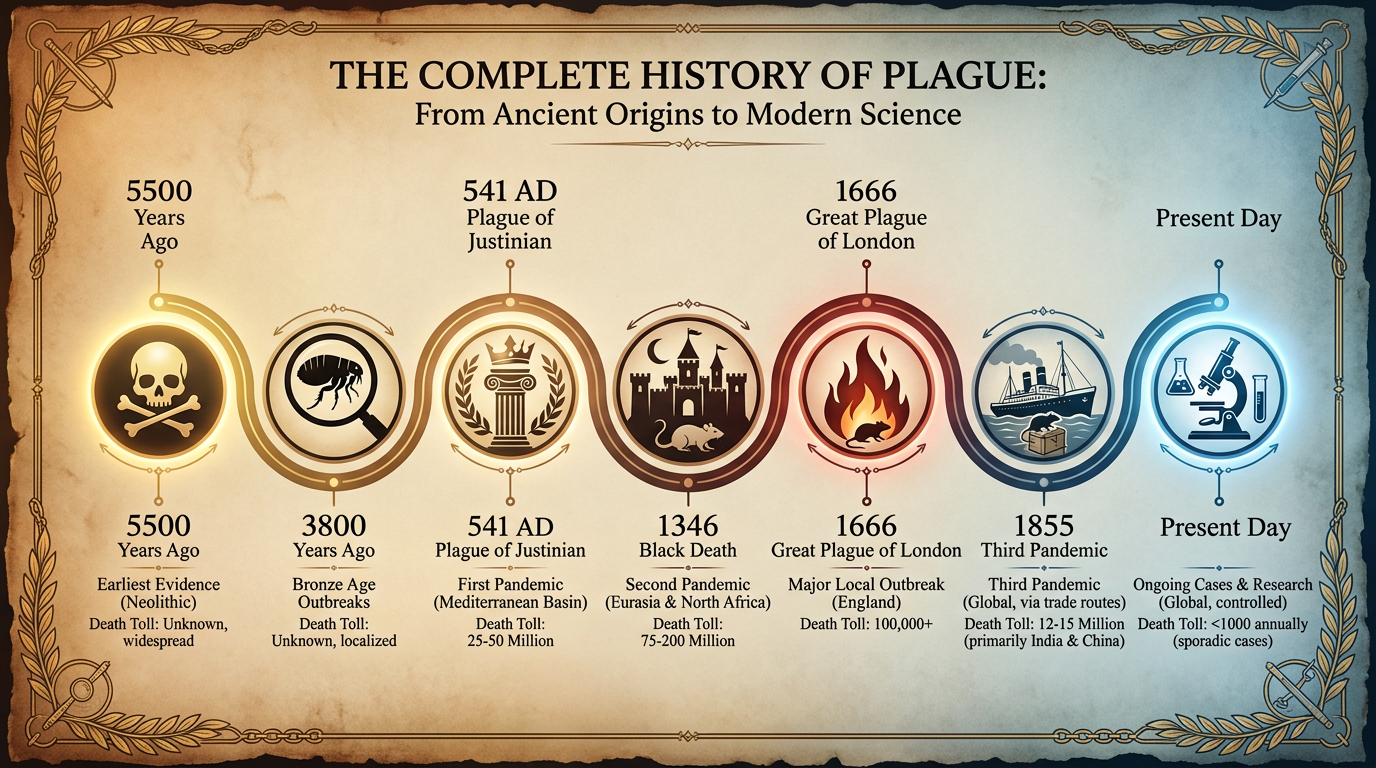
Here’s the updated timeline of plague in human history, incorporating this ancient plague discovery:
| Period | Event | Estimated Deaths |
| ~5,500 years ago | Earliest known plague outbreaks (Lake Baikal, Siberia) | Unknown (family-level devastation) |
| ~5,300 years ago | Previously known oldest cases | Unknown |
| ~3,800 years ago | Plague evolves flea-based transmission | N/A (evolutionary milestone) |
| 541-549 AD | Plague of Justinian | 25-50 million |
| 1346-1353 | The Black Death | 75-200 million |
| 1665-1666 | Great Plague of London | ~100,000 |
| 1855-1960 | Third Pandemic | 12-15 million |
| Present day | Sporadic cases worldwide | ~600/year |
The Great Fire of London Myth
While we’re debunking plague myths, here’s another one: the Great Fire of London in 1666 did NOT end the Great Plague. This is a widely believed misconception.
Recent historical research confirms that the plague was already declining before the fire, and the fire primarily destroyed areas that had already been heavily affected. The actual end of the plague was likely due to a combination of quarantine measures, changes in rat populations, and natural burnout of the epidemic.
The Researchers Behind This Groundbreaking Discovery
The ancient plague discovery was made possible by an international team of scientists, with key contributors including:
- Eske Willerslev (University of Copenhagen) evolutionary geneticist and study co-author
- Ruairidh Macleod (University of Cambridge) who noted they built “a really clear, complete picture of what happened during these outbreaks”
The study was published in Nature on June 17, 2026, and represents years of collaborative work between institutions across Europe and Russia.
FAQs About the Ancient Plague Discovery
What is the oldest plague ever found?
The oldest plague ever found dates to approximately 5,500 years ago, discovered in hunter-gatherer cemeteries near Lake Baikal in southeast Siberia. This ancient plague discovery was announced in June 2026 and pushes back the known timeline of plague by about 200 years.
How did ancient plague spread without fleas?
The ancient plague strains found in 5,500-year-old remains lacked the virulence factors needed for flea-based transmission. Scientists believe it spread through direct human-to-human contact, likely in pneumonic form through respiratory droplets, similar to how pneumonic plague spreads today.
Did hunter-gatherers really get plague?
Yes. This ancient plague discovery proves definitively that mobile hunter-gatherer communities suffered devastating plague outbreaks. The 39% detection rate in cemetery remains shows that plague was a major killer even before agriculture developed.
Is the ancient plague the same as the Black Death?
Both are caused by the same bacterium, Yersinia pestis, but the ancient strains were genetically different. They lacked the molecular tools for flea-mediated transmission that made the Black Death so catastrophically contagious across medieval Europe.
Can plague still affect humans today?
Yes. Plague still infects several hundred people annually worldwide. It’s treatable with antibiotics if caught early, but remains fatal without treatment. Cases are reported in Africa, Asia, and even the western United States.
Why is this ancient plague discovery important?
It overturns the theory that plague required agricultural settlements to become deadly. It proves that even small, mobile human groups were vulnerable to devastating outbreaks, and that human-to-human plague transmission existed thousands of years earlier than previously thought.
Where was the ancient plague found?
The ancient plague was found in four separate hunter-gatherer cemeteries near Lake Baikal in southeast Siberia, Russia. Lake Baikal is the world’s deepest freshwater lake, and the region was home to thriving hunter-gatherer communities during the mid-Holocene period.
Final Thoughts: Why This Ancient Plague Discovery Matters to You
Look, I get it. A 5,500-year-old plague outbreak might feel pretty disconnected from your daily life. But here’s why this ancient plague discovery should matter to every single one of us.
We are not as safe as we think. Every pandemic in history has caught humanity off guard. The people at Lake Baikal 5,500 years ago didn’t see it coming. Medieval Europeans didn’t see the Black Death coming. We didn’t see COVID-19 coming.
History repeats, but it also evolves. Just like Yersinia pestis evolved new weapons over thousands of years, modern pathogens are constantly adapting. Understanding how diseases evolve through deep time helps us predict and prepare for the next threat.
Every discovery reshapes our understanding. Five years ago, if you’d asked scientists when plague first became deadly to humans, they’d have given you the wrong answer. This ancient plague discovery proves that our understanding of history is always incomplete, always evolving, always open to revision.
The story of plague is ultimately the story of humanity: resilient, adaptive, and constantly engaged in a battle with the invisible world of microorganisms. Understanding that story, from its earliest chapters 5,500 years ago to today, is not just academic curiosity.
It’s survival knowledge.
Sources:
- Willerslev, E. et al. (2026). “Lethal plague outbreaks in Lake Baikal hunter-gatherers 5,500 years ago.” Nature.
- Associated Press. “Ancient teeth from Siberia rewrite the plague’s timeline.” June 17, 2026.
- University of Cambridge. “Oldest strains of plague caused deadly outbreaks 5,500 years ago.” June 17, 2026.
- CIDRAP. “Ancient DNA reveals a plague outbreak in Siberia 5,500 years ago.” June 17, 2026.