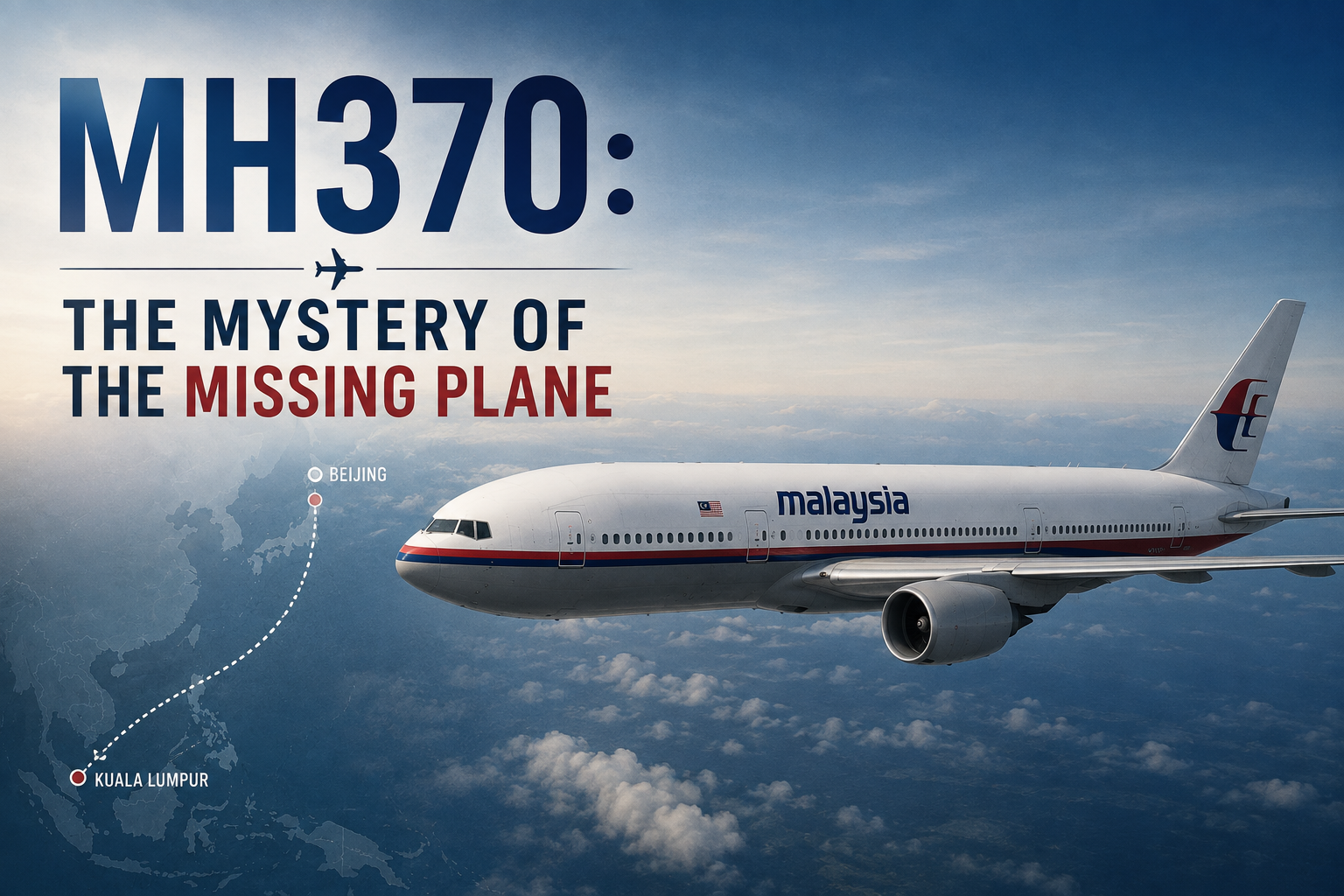
On March 8, 2014, a Boeing 777 carrying 239 people took off from Kuala Lumpur bound for Beijing. Forty minutes into the flight, it disappeared from radar. It was the beginning of the most baffling, most expensive, and most heartbreaking aviation mystery in modern history. The MH370 mystery has produced the largest underwater search in human history, recovered 33 pieces of confirmed or probable debris washed onto distant shores, and generated a satellite data analysis that changed how aviation tracks aircraft forever. It has not produced an answer. More than eleven years later, MH370 has never been found. The 239 people on board have never been accounted for. And the question of what really happened on that flight remains genuinely unanswered. This is everything we actually know — and why it still isn’t enough.
| Updated: September 2026 | 30 Min Read | ✈ Indian Ocean · March 8, 2014 | STATUS: UNSOLVED |
Malaysia Airlines Flight MH370 — a Boeing 777-200ER that disappeared on March 8, 2014, with 239 people on board. The MH370 mystery triggered the largest and most expensive underwater search in aviation history, costing over $200 million USD. Despite years of searching across thousands of kilometers of the southern Indian Ocean, the main wreckage has never been found. 33 pieces of confirmed or probable debris have washed ashore on islands and coastlines thousands of miles from the search zone. The plane, the answers, and the 239 people remain missing.
The MH370 mystery is unlike any aviation disaster in history — because it is not, technically, a disaster in the traditional sense. There was no mayday call. No explosion caught on radar. No distress signal. No wreckage found at the point of disappearance. A Boeing 777 — one of the most reliable aircraft ever built — simply ceased to communicate with the outside world forty minutes after takeoff, turned around, flew for hours in a different direction, and then disappeared into one of the most remote and deepest stretches of ocean on earth.
The MH370 mystery sits at the intersection of aviation technology, geopolitics, satellite mathematics, ocean science, and human psychology in ways that no previous disappearance has. Understanding it properly requires understanding all of these dimensions simultaneously — and being honest about what the evidence actually shows versus what has been speculated, sensationalized, or simply invented to fill the silence that surrounds this case.
This article presents everything that is actually known about the MH370 mystery — the confirmed facts, the satellite data, the debris, the credible theories, and the honest assessment of what investigators believe happened. It also presents the things that are not known and may never be known. Because after eleven years, 33 pieces of debris, and over $200 million spent searching, the fundamental question — what happened to MH370 — still does not have a proven answer.
☰ TABLE OF CONTENTS
- MH370: The Flight, the Aircraft, the People
- March 8, 2014: The Last 40 Minutes of Normal
- “Good Night, Malaysian Three Seven Zero”: The Final Communication
- The Turn: How MH370 Disappeared From Radar
- ACARS and Transponder: The Two Systems That Went Silent
- The Satellite Handshakes: How Inmarsat Changed Everything
- The Southern Arc: Why Investigators Believe MH370 Went South
- The Search: The Largest and Most Expensive in History
- The Debris: 33 Pieces and What They Prove
- The Captain: Zaharie Ahmad Shah and What Investigators Found
- The Major Theories: What the Evidence Actually Supports
- The Fuel Exhaustion Endgame: How the Plane Likely Hit the Water
- New Search 2024–2025: What Ocean Infinity Is Looking For
- What the MH370 Mystery Changed About Aviation Forever
- Frequently Asked Questions
1. MH370: The Flight, the Aircraft, and the 239 People on Board

The MH370 mystery begins with a specific aircraft on a routine route. Malaysia Airlines Flight MH370 was operated by a Boeing 777-200ER — registration 9M-MRO — one of the safest and most technologically sophisticated commercial aircraft ever manufactured. The Boeing 777 had, at the time of MH370’s disappearance, one of the best safety records in commercial aviation history. It was a mature, proven aircraft with extensive redundant systems and had never experienced a fatal accident due to mechanical failure in over fifteen years of commercial operation.
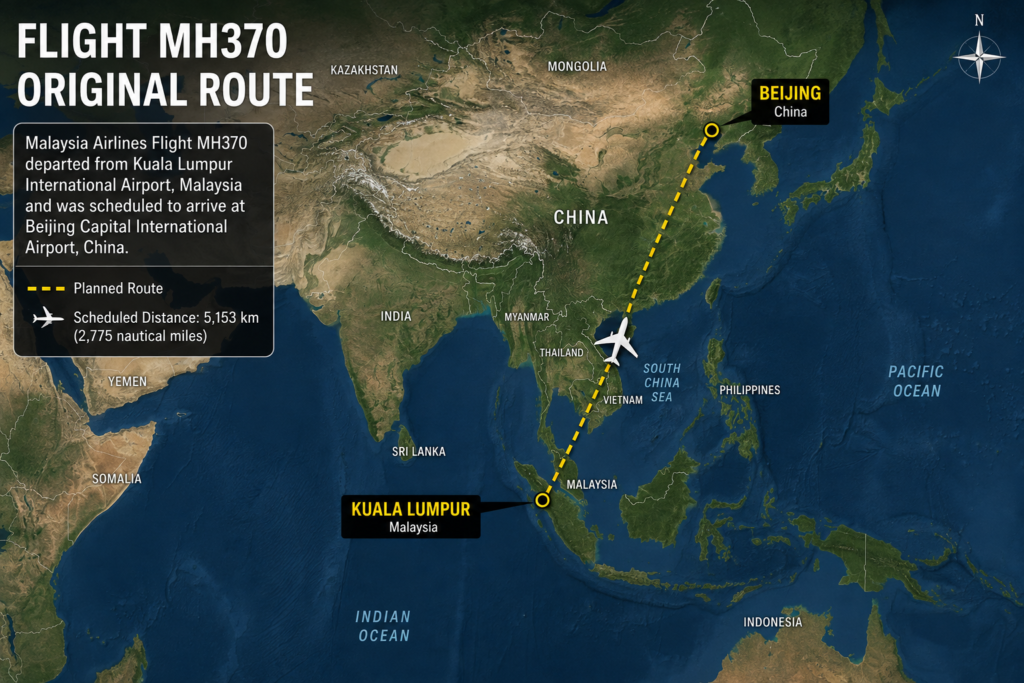
The flight was operating the Kuala Lumpur to Beijing route — a regular, commercially busy service that Malaysia Airlines operated multiple times weekly. It was scheduled to be a roughly six-hour flight, departing Kuala Lumpur International Airport at 12:41 AM local time on March 8, 2014, and arriving at Beijing Capital International Airport at 6:30 AM local time.
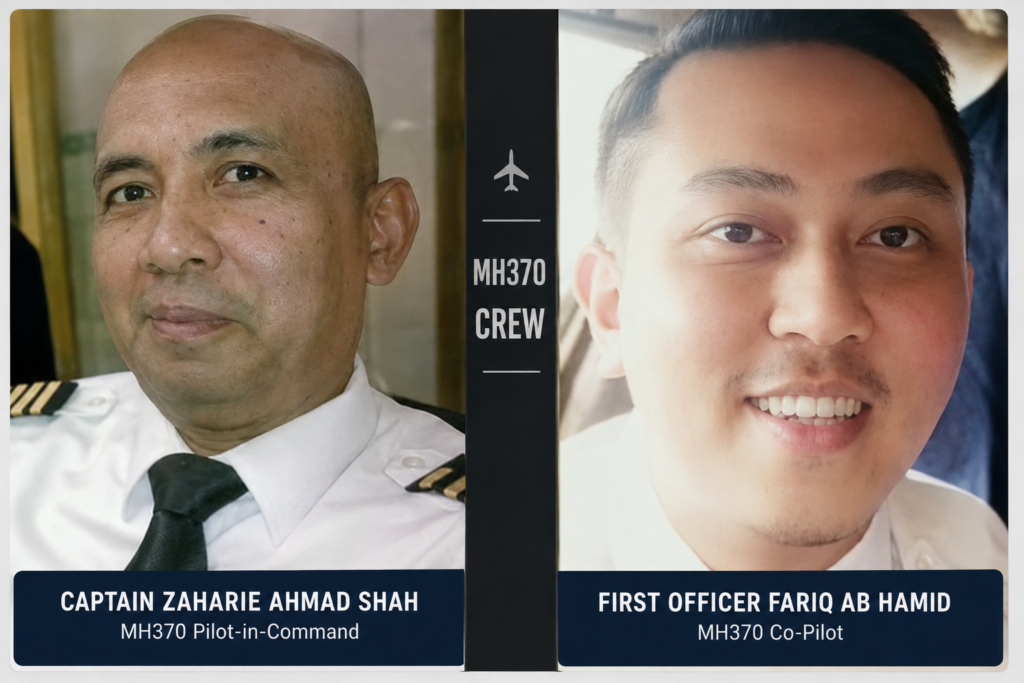
On board were 239 people: 227 passengers and 12 crew members. The passengers were predominantly Chinese nationals — 153 of the 227 — along with passengers from Malaysia, Indonesia, Australia, India, France, the United States, and eleven other countries. They included families, business travelers, a group of Chinese artists returning from an exhibition, and children as young as 2 years old. The crew of 12 was led by Captain Zaharie Ahmad Shah, 53, with 18,365 flight hours of experience, and First Officer Fariq Abdul Hamid, 27. Every one of those 239 people had a name, a family, a story that the MH370 mystery erased from the world without explanation or trace.
| 239 People on board MH370 — 227 passengers, 12 crew |
7+ hrs Flight continued after last radar contact — tracked by satellite |
$200M+ Cost of the underwater search — largest in aviation history |
33 Pieces of confirmed or probable MH370 debris found on beaches |
0 Main wreckage found — the MH370 mystery remains officially unsolved |
2. March 8, 2014: The Last 40 Minutes of Normal Flight
The route of MH370 as it departed Kuala Lumpur International Airport at 12:41 AM on March 8, 2014. The first 40 minutes of the flight were entirely routine — the aircraft climbed normally, communicated normally, and proceeded on its expected route northeast toward Vietnam and China. At 1:19 AM, the last voice communication from the cockpit was received. At 1:21 AM, the aircraft’s transponder stopped transmitting. The MH370 mystery began at that moment.
The MH370 mystery did not begin at takeoff. For the first forty minutes of the flight, everything was entirely, unremarkably routine. At 12:41 AM local time (16:41 UTC) on March 8, 2014, MH370 pushed back from Gate C1 at Kuala Lumpur International Airport. Takeoff occurred at 12:42 AM. The aircraft climbed normally through Malaysian airspace, communicating routinely with Kuala Lumpur Air Traffic Control.
At 1:01 AM, MH370 reached its cruising altitude of 35,000 feet. At 1:08 AM, the aircraft’s ACARS system — a datalink that automatically transmits aircraft performance and positioning data — sent its last routine report to Malaysia Airlines operations control. Everything in that report was normal. At 1:19:24 AM, First Officer Fariq Abdul Hamid made the final voice communication from MH370 to Kuala Lumpur ATC, acknowledging a frequency change to Ho Chi Minh City control as the aircraft prepared to enter Vietnamese airspace: “Good night, Malaysian Three Seven Zero.”
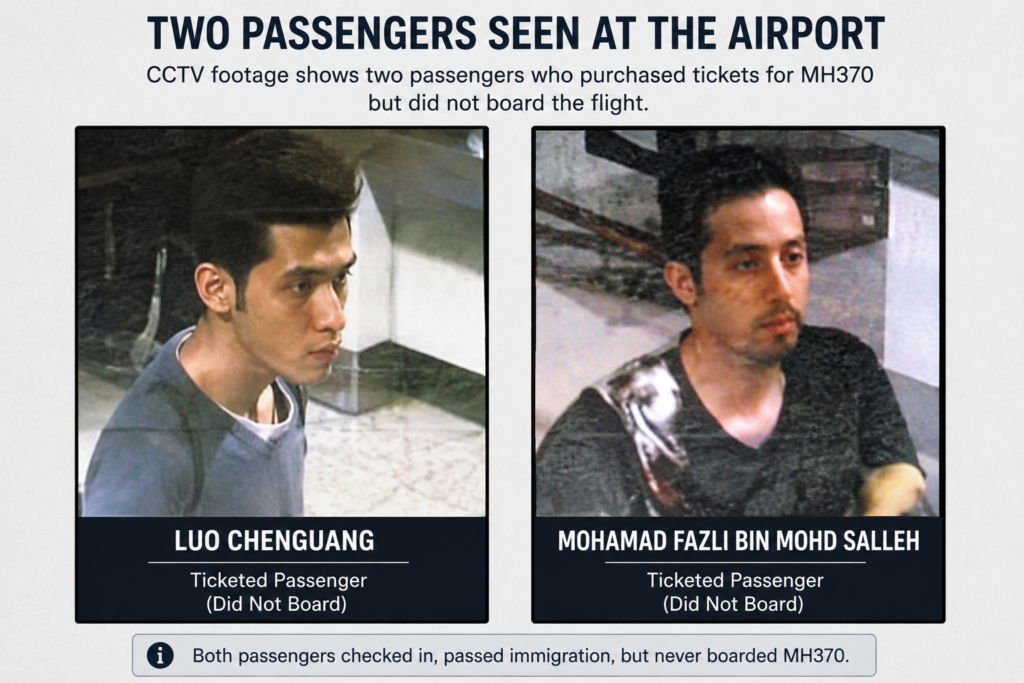
At 1:21 AM — ninety-six seconds after that last routine farewell — MH370’s transponder stopped transmitting. Ho Chi Minh City control called MH370 and received no response. They called again. No response. Kuala Lumpur tried to reach the aircraft. No response. Within minutes, what had been a routine overnight flight had become something else entirely — and the MH370 mystery that would consume the aviation world for years had begun. In ninety-six seconds, a Boeing 777 with 239 people on board went from a routine commercial flight to the most baffling aviation disappearance in human history.
3. “Good Night, Malaysian Three Seven Zero”: Why Those Six Words Matter So Much
The final words from MH370 — “Good night, Malaysian Three Seven Zero” — have been analyzed, debated, and interpreted countless times in the context of the MH370 mystery. They were spoken by First Officer Fariq Abdul Hamid at 1:19:24 AM local time, acknowledging Kuala Lumpur ATC’s instruction to contact Ho Chi Minh City on a new frequency as the aircraft approached Vietnamese airspace.
The phrasing has attracted attention for two reasons. First, standard ATC protocol in that region called for the departing crew to read back the new frequency before signing off — Fariq said “Good night” without reading back the frequency, which is a minor but noted deviation from standard procedure. Second, “Good night” rather than “Goodnight” (one word) is a slightly informal phrasing that some analysts have flagged as possibly suggesting the final communication was made with less attention or formality than expected. Investigators have assessed both of these details. Neither has been established as significant. The phrasing could simply reflect the conversational habits of a 27-year-old pilot on a routine overnight flight at 1:19 AM.
What is certain is that ninety-six seconds after those final words, the transponder went silent. And whoever spoke those six words — whether it was Fariq alone, whether someone else was in the cockpit, whether the person speaking them knew what was about to happen — is part of the MH370 mystery that has never been resolved. “Good night, Malaysian Three Seven Zero” is now one of the most analyzed farewell phrases in aviation history. We still don’t know who said it with full understanding of what it meant.
“Good night, Malaysian Three Seven Zero.”
— First Officer Fariq Abdul Hamid, 1:19:24 AM local time, March 8, 2014 — the last words ever transmitted from MH370. Ninety-six seconds later, the aircraft’s transponder went silent. The MH370 mystery had begun.
4. The Turn: How MH370 Disappeared From Radar and Then Reappeared Going the Wrong Way
When MH370’s transponder stopped transmitting at 1:21 AM, the aircraft did not simply disappear. What happened next is one of the most documented and most significant aspects of the entire MH370 mystery — because the plane did not crash at that point. It turned around.
Malaysian military radar — which tracks all objects in Malaysian airspace regardless of whether they are transmitting a transponder signal — captured what happened next. The radar return showed that MH370, after its transponder went dark, made a left turn and reversed course. Instead of continuing northeast toward Vietnam and China, the aircraft turned southwest, flew back across the Malay Peninsula, passed near Penang (Malaysia’s second-largest city) at an altitude that one radar operator reported as approximately 12,000 feet — possibly suggesting a descent and then re-climb — and then turned northwest, flying across the northern end of the Strait of Malacca toward the Indian Ocean.
This turn was deliberate. The investigators’ assessment, documented in the official Malaysian safety investigation report released in 2018, is unambiguous on this point: the course changes that MH370 made after its transponder was disabled were consistent with deliberate inputs to the aircraft’s flight management system, not with any mechanical failure or emergency scenario. The aircraft followed specific waypoints. It crossed Malaysian airspace without responding to military communications. Someone was flying MH370 in a deliberate direction after all communications had been cut. That is not a theory. That is what the radar data shows. And it is one of the most disturbing established facts of the entire MH370 mystery.
5. ACARS and the Transponder: The Two Communication Systems That Went Silent
Understanding the MH370 mystery requires understanding two specific aviation communication systems whose deactivation — or failure — is at the technical heart of the disappearance.
The transponder is the system that allows an aircraft to communicate its identity and position to air traffic control radar. When the transponder is active, ATC radar sees not just a radar return (a blip showing something is there) but a specific identified aircraft with its flight number, altitude, and speed. When MH370’s transponder went silent at 1:21 AM, it became, to civilian ATC, invisible — because civilian radar systems do not track unidentified returns. Military radar, which does track all returns, continued to see MH370.
ACARS (Aircraft Communications Addressing and Reporting System) is a datalink system that automatically transmits short data messages — aircraft performance data, position reports, maintenance information — at regular intervals. MH370’s ACARS had been scheduled to transmit next at approximately 1:37 AM. That transmission never came. The ACARS system had been disabled or its data link deactivated before the 1:37 AM scheduled transmission window.
The sequence of these two events — the ACARS going silent before 1:37 AM and the transponder going silent at 1:21 AM — combined with the subsequent deliberate course change, led investigators to conclude that both systems were intentionally disabled. The actions required to disable these systems are not accidental — they require specific knowledge of the aircraft’s systems and deliberate cockpit inputs. The MH370 mystery is not a mystery about an aircraft that broke down. It is a mystery about an aircraft whose communication systems were deliberately disabled by someone who knew exactly how to do it.
6. The Inmarsat Satellite Handshakes: The Data That Changed the MH370 Mystery Forever
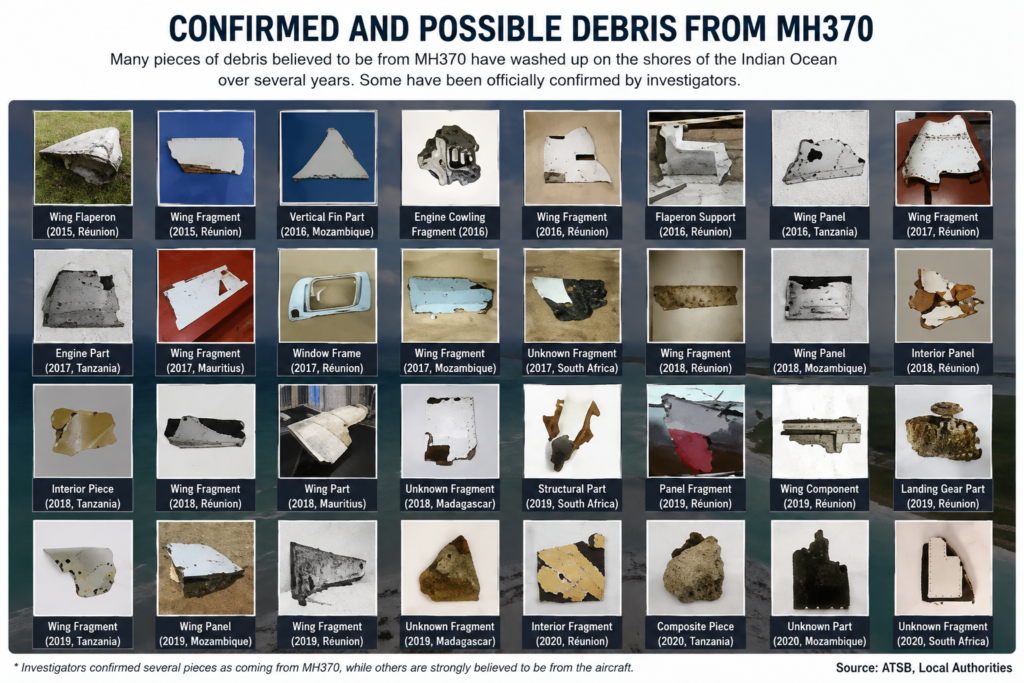
The Inmarsat satellite data analysis that defined the MH370 mystery search zone. After MH370’s transponder and ACARS were disabled, the aircraft continued to send periodic “handshake” signals to the Inmarsat-3F1 satellite — automated pings that the satellite sent to confirm the aircraft’s communication system was still online, even though no data was being transmitted. Analysis of the timing and frequency of these pings — using Doppler shift calculations — allowed investigators to determine that MH370 had flown south into the Indian Ocean and likely ended its flight in a remote zone of the southern Indian Ocean. This satellite analysis, unprecedented in aviation history, directed the entire subsequent search.
The single most important technical development in understanding the MH370 mystery — the discovery that changed the search from a regional operation to a global one — came from a British satellite communications company called Inmarsat.
MH370’s satellite communication system — even though ACARS data transmission had been disabled — continued to automatically exchange periodic “handshake” signals with the Inmarsat-3F1 geostationary satellite over the Indian Ocean. These handshakes — called BTO/BFO pings — are not data transmissions. They are simply automated check-in signals that the satellite sends to ask “are you still there?” and that the aircraft’s system responds to with “yes.” They contain no position data, no flight data, nothing useful about the aircraft’s location — just a timestamp and a frequency measurement.
Inmarsat’s engineers recognized that these timing and frequency measurements — specifically the Doppler shift in the frequency caused by the relative motion of the aircraft and the satellite — could be used to calculate which direction MH370 was traveling and roughly how far it was from the satellite at each ping. Using this unprecedented analysis, Inmarsat determined that MH370 had continued flying for approximately seven hours after its transponder went dark, and that its final path had taken it into the southern Indian Ocean — not north, as had initially been suspected. The last satellite handshake occurred at 8:19 AM local time, followed approximately ninety minutes later by a partial handshake that investigators believe occurred when the aircraft’s left engine flamed out due to fuel exhaustion. The Inmarsat analysis fundamentally changed the MH370 mystery. It did not tell us where MH370 was. It told us where it went. And it redirected the entire search — and the attention of the world — toward one of the most remote patches of ocean on earth.
7. The Southern Arc: Why Investigators Believe MH370 Went South into the Indian Ocean
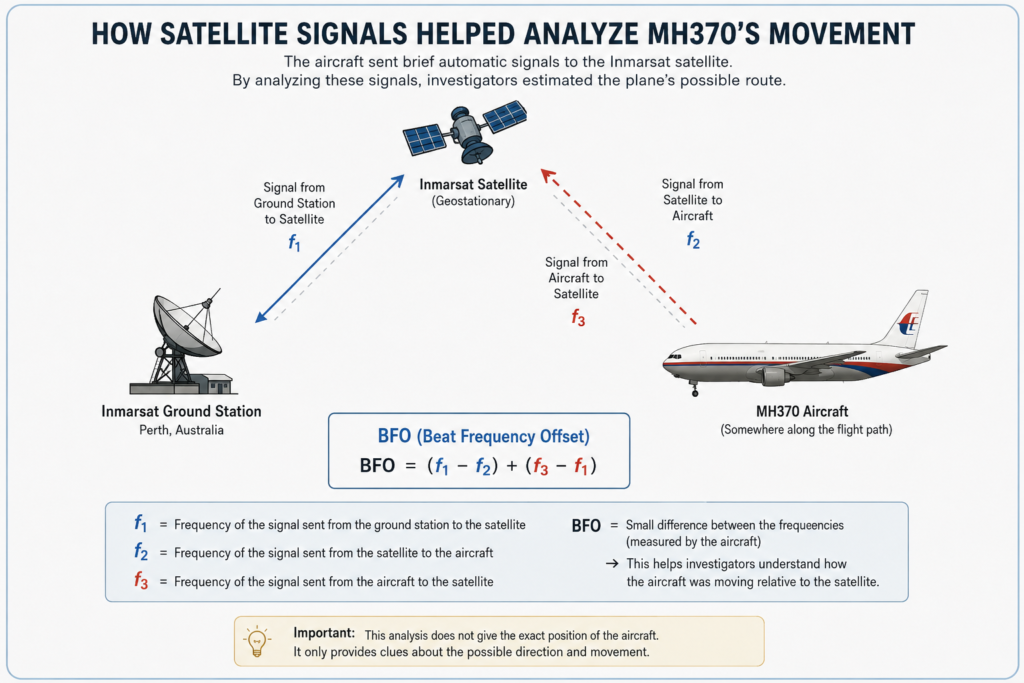
The Inmarsat satellite data established that MH370 had crossed the Andaman Sea, passed over the northern Strait of Malacca, and then turned south — flying deep into the southern Indian Ocean over the course of approximately seven hours. The final “arc” — the range of possible locations consistent with the last satellite handshake — defines the area investigators have concentrated the search.
The decision that MH370 went south rather than north was made after investigators ruled out the northern arc: military radar coverage across Central and South Asia would likely have detected a large Boeing 777 if it had flown north, and no such detection was reported despite significant intelligence-gathering efforts in the months following the disappearance. The southern arc, by contrast, passes over some of the most remote and radar-free airspace on earth — where a large aircraft could fly for hours completely undetected by any ground-based system.
The most likely crash zone, based on the satellite data analysis and drift modeling of the confirmed debris, is a section of the southern Indian Ocean roughly 1,800 kilometers west of Perth, Australia — an area where the ocean reaches depths of 3,000 to 4,000 meters, where the sea floor is extremely rugged with ridges, valleys, and seamounts, and where conditions for underwater search operations are among the most challenging on earth. The Australian Transport Safety Bureau (ATSB) led the primary underwater search of this zone. The area is so remote that before the MH370 mystery search, significant portions of the ocean floor there had never been mapped. The search created the most detailed bathymetric maps of the southern Indian Ocean ever produced.
8. The Search: The Largest and Most Expensive Underwater Search in History
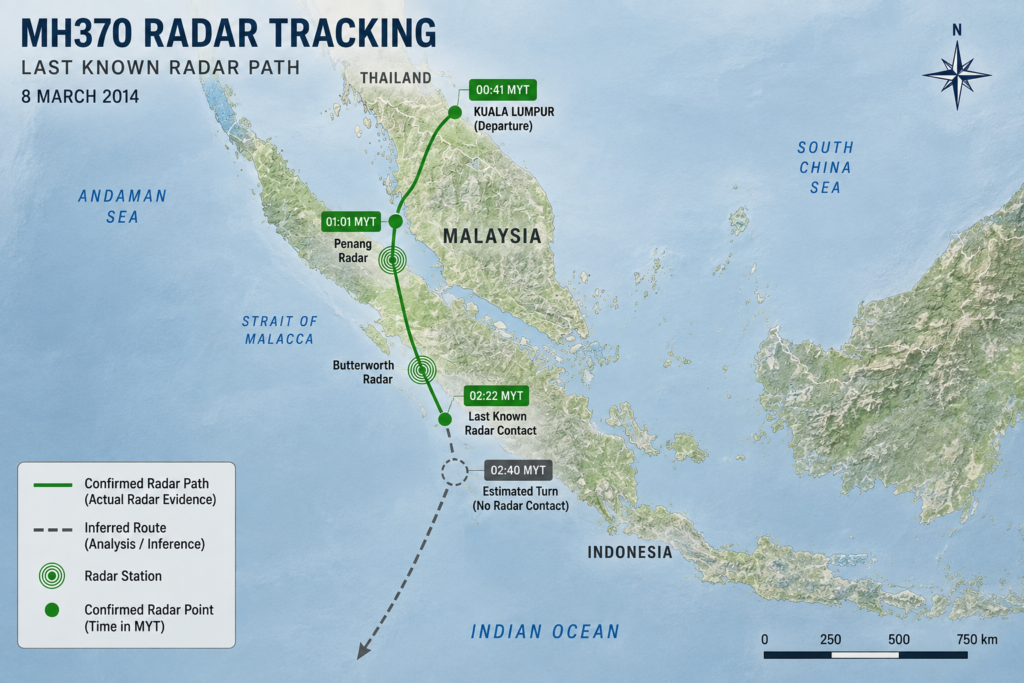
An underwater search vessel operating in the southern Indian Ocean as part of the MH370 mystery investigation. The ATSB-led search covered approximately 120,000 square kilometers of ocean floor at depths of up to 4,000 meters — using autonomous underwater vehicles (AUVs) equipped with sonar and cameras to create detailed maps of the sea floor. The search was suspended in January 2017 without finding the main wreckage. Ocean Infinity’s subsequent searches in 2018 and 2024–2025 covered additional areas. The main wreckage of MH370 has not been found.
The search for MH370 became the largest, most expensive, and most technologically advanced underwater search operation in the history of aviation. The MH370 mystery demanded it — because the aircraft had disappeared into one of the most remote, deep, and poorly mapped sections of ocean on earth.
The initial surface search, launched immediately after the disappearance, covered vast areas of ocean and found nothing related to MH370. The underwater search, led by the Australian Transport Safety Bureau (ATSB) and funded jointly by Australia, Malaysia, and China, began in October 2014 using specialized vessels towing deep-water sonar equipment. By January 2017, when the search was suspended, approximately 120,000 square kilometers of ocean floor had been systematically mapped and searched at depths of up to 4,000 meters. Cost: approximately $200 million USD. Result: no main wreckage.
In 2018, ocean technology company Ocean Infinity conducted a private no-find-no-fee search using eight autonomous underwater vehicles operating simultaneously — covering additional areas of the southern arc. Again: no main wreckage. The search was eventually extended and refined as new drift analysis of the recovered debris refined the probable crash location. The failure to find the main wreckage of MH370 is not evidence that the aircraft is not in the southern Indian Ocean. It is evidence of how extraordinarily difficult it is to find a single aircraft in 4,000 meters of water across hundreds of thousands of square kilometers of unmapped ocean floor.
9. The Debris: 33 Pieces Washed Ashore — What They Prove About the MH370 Mystery
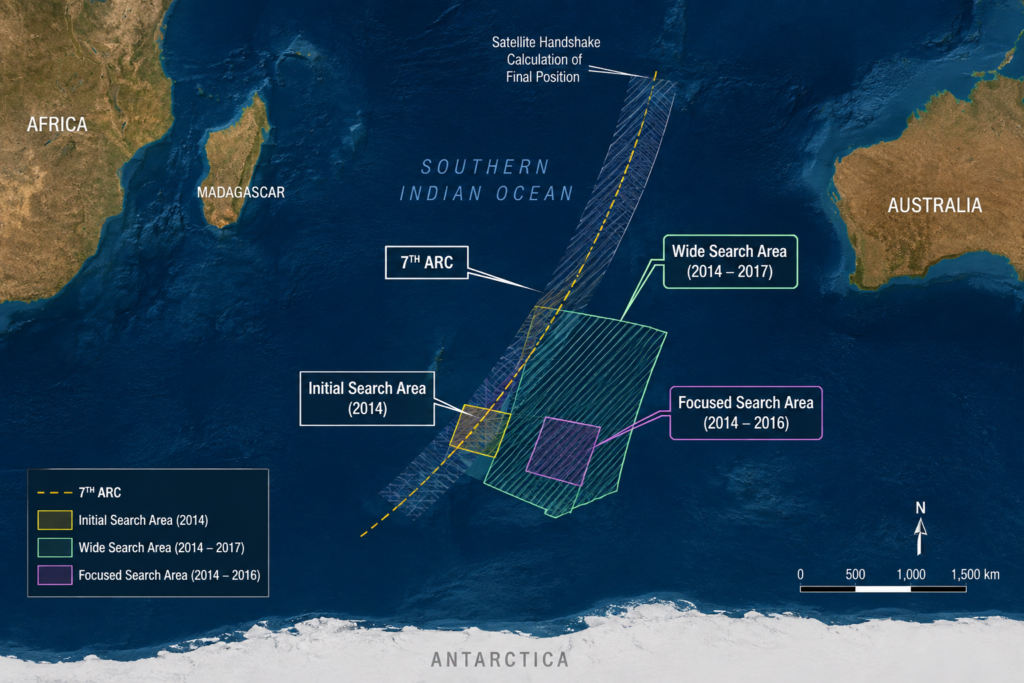
While the main wreckage of MH370 has never been found, the MH370 mystery is not without physical evidence. Beginning in July 2015, pieces of debris consistent with originating from MH370 began washing ashore on islands and coastlines in the western Indian Ocean — and the pattern of that debris provides the strongest physical confirmation that MH370 crashed in the southern Indian Ocean.
The first and most significant piece was a flaperon — a section of the wing’s trailing edge — found on Réunion Island on July 29, 2015, approximately 3,700 kilometers west of the primary search zone. The flaperon was examined by French and Malaysian investigators and confirmed as originating from a Boeing 777. Boeing confirmed it matched the part number from MH370. Drift analysis — modeling ocean currents backward from Réunion to determine where the flaperon must have entered the water — was consistent with the southern Indian Ocean search zone.
As of 2025, 33 pieces of confirmed or probable MH370 debris have been recovered from beaches and shorelines on Réunion Island, Mozambique, Tanzania, South Africa, Madagascar, Mauritius, and the Maldives — all locations consistent with drift modeling from the suspected crash area in the southern Indian Ocean. These include wing components, interior panels, a horizontal stabilizer, and items that appear to be personal belongings of passengers. One piece of debris — a section of interior panel — contained handwritten text in Chinese characters that has been interpreted as a message from someone on the aircraft, though this interpretation has not been officially confirmed.
■ KEY CONFIRMED DEBRIS PIECES FROM MH370 MYSTERY — DOCUMENTED
► Flaperon — Réunion Island, July 2015. Confirmed Boeing 777 component, matched to MH370 serial number. First confirmed physical evidence
► Outboard flap section — Mozambique, March 2016. Confirmed MH370 debris
► Horizontal stabilizer section — South Africa. Confirmed MH370 debris
► Interior furnishing panels — Multiple locations. Probable MH370 debris
► Seat cushion — Consistent with Boeing 777 interior, probable MH370 debris
► Titanium component — Recovered and assessed as probable MH370 debris
► Total as of 2025: 33 pieces confirmed or probable, from seven different countries or territories
The debris evidence is significant in what it confirms — that MH370 crashed into the southern Indian Ocean — and in what it does not reveal: the debris pattern has been used to refine the probable impact zone, but it has not narrowed the search area to a precise location. The MH370 mystery remains unresolved because “the southern Indian Ocean” is a search area spanning hundreds of thousands of square kilometers of unmapped, 4,000-meter-deep ocean.
10. Captain Zaharie Ahmad Shah: What Investigators Found — and What It Does and Doesn’t Mean
Any honest discussion of the MH370 mystery must address Captain Zaharie Ahmad Shah — not as a conclusion, but as the central person of interest whose background investigators examined most thoroughly, and whose conduct before and during the flight is the most discussed aspect of every serious analysis of the case.
Captain Zaharie was 53 years old and had 18,365 flying hours with Malaysia Airlines — an extraordinarily experienced pilot with a well-regarded professional reputation. He was passionate about aviation, maintained a home flight simulator, and was known among aviation enthusiasts for his detailed knowledge of Boeing 777 systems. He was also, by the accounts of those who knew him, a complex and emotionally engaged person who was, in the period leading up to the flight, reportedly going through personal difficulties.
The investigation of Captain Zaharie’s home flight simulator produced what is the most discussed finding in the entire MH370 mystery investigation. Analysis of deleted data from the simulator found evidence that, in the months before March 8, 2014, someone had practiced flying a route in the simulator that took a Boeing 777 south into the remote southern Indian Ocean and then ran it until it ran out of fuel. This route bore a structural resemblance to the route MH370 appears to have taken. Investigators from multiple countries assessed this simulator data. Australian investigators who examined it described it as significant. The Malaysian safety investigation report acknowledged it without drawing a definitive conclusion.
It is critical to state clearly what this evidence does and does not establish about the MH370 mystery. It does not prove that Captain Zaharie deliberately flew MH370 into the southern Indian Ocean as an act of deliberate mass murder. Pilot simulators are used to practice challenging routes. The deleted data could represent planning for a deliberate act, or it could represent something else entirely. The investigation found no suicide note, no final communications, no farewell to family, and no clear financial or personal motive. No one who knew Zaharie has said they believed him capable of this. His family has consistently and strongly rejected any suggestion of deliberate action on his part. The simulator data is the most significant piece of evidence pointing toward deliberate action by someone in the cockpit. It is not conclusive. In the MH370 mystery, nothing is conclusive.
“The evidence surrounding the disappearance of MH370 is consistent with the deliberate action of a person or persons on board the aircraft. The motivation, however, remains unknown.”
— Australian Transport Safety Bureau (ATSB), in the final report on the MH370 mystery search, January 2017
11. The Major Theories: What the Evidence Actually Supports in the MH370 Mystery
The MH370 mystery has generated an extraordinary volume of theories — from the technically sophisticated to the genuinely absurd. Below are the theories that serious investigators and analysts have considered most carefully, with an honest assessment of the evidence supporting and undermining each.
① Deliberate Action by the Pilot — Most Supported by Evidence
The MH370 mystery‘s most evidence-supported theory: Captain Zaharie deliberately disabled communications, made deliberate course changes, and flew MH370 to its end in the southern Indian Ocean. For: The ACARS and transponder were disabled before the turn; the subsequent course changes were deliberate inputs to the flight management system; the simulator route data; the seven-plus hours of controlled flight after the turn. Against: No confirmed motive; no farewell communications; no financial irregularities; character witnesses strongly dispute the characterization; this remains a theory, not a proven fact.
② Hypoxia Event — Crew Incapacitation After Depressurization
A catastrophic depressurization event could have incapacitated crew and passengers, with the aircraft then flying on autopilot on the pre-programmed route until fuel exhaustion. The turn and communication cutoffs could have been a crew response to an emergency that then incapacitated them. For: Does not require attributing criminal intent to anyone; precedent from other accidents (Helios Airways Flight 522). Against: Does not adequately explain the deliberate disabling of ACARS before the transponder went dark; or why the aircraft then flew a specific navigated route rather than continuing on its original programmed path.
③ Fire or Catastrophic Mechanical Failure
An onboard fire — possibly in the cargo hold, which contained lithium-ion batteries listed on the manifest — or other catastrophic mechanical failure, caused the crew to disable systems, attempt to turn back, and then succumb before reaching safety. For: Precedent from other accidents; MH370 carried 221 kilograms of lithium-ion batteries in the cargo hold; explains communication loss. Against: Does not explain the extended controlled flight for seven-plus hours after the turn; fire severe enough to kill the crew typically does not allow extended controlled flight.
④ Hijacking or Third Party Action
Someone other than the captain — a passenger, a crew member, or someone who gained access to the cockpit — took control of MH370. For: Does not require attributing motive to the captain; consistent with the evidence of deliberate action. Against: No passenger with the aircraft systems knowledge required for the specific actions taken has been identified; no group or individual has claimed responsibility; the extended flight and the simulator data are more consistent with someone with deep Boeing 777 knowledge.
12. The Fuel Exhaustion Endgame: How MH370 Most Likely Hit the Water
One of the most technically important aspects of the MH370 mystery is the analysis of how the aircraft likely ended its flight — because this analysis shapes where investigators believe the main wreckage should be, and why it has not been found in the areas searched so far.
MH370’s last satellite handshake occurred at 8:19 AM on March 8, 2014 — approximately seven hours and thirty-eight minutes after takeoff. Shortly after this final ping, a partial handshake — what investigators call a “log-on request” — was received. This partial handshake is consistent with what occurs when an aircraft experiences a sudden power interruption and the satellite communication system automatically tries to re-establish connection. The most likely cause of such an interruption is fuel exhaustion — the left engine flaming out when fuel ran dry.
After fuel exhaustion, a Boeing 777 would have approximately 8 minutes of flight remaining as both engines flamed out sequentially and the aircraft lost power. The key question for locating the wreckage is whether anyone was at the controls during this final phase — because a controlled glide from a skilled pilot could have placed the aircraft significantly further from the point of fuel exhaustion than an uncontrolled spiral descent. This is the technical heart of why the MH370 mystery search has been so difficult: investigators cannot be certain of the final flight path in those last minutes, and a difference of even a few minutes of controlled flight versus uncontrolled descent changes the crash location by potentially hundreds of kilometers.
13. New Search 2024–2025: What Ocean Infinity Is Looking For Now
The MH370 mystery search did not end with the suspension of the ATSB search in January 2017. Ocean Infinity — the same company that conducted the 2018 search — reached a new agreement with the Malaysian government to conduct an additional search, with renewed operations beginning in 2024 and continuing into 2025.
The 2024–2025 search is targeting a new area of the southern Indian Ocean identified through refined analysis of both the satellite data and the drift modeling of the recovered debris. Independent researchers and groups including the ATSB’s own scientists and the IG (Independent Group of aviation and satellite experts who have worked on the case since 2014) have advocated for searching an area slightly north of the original primary search zone — roughly centered around 35°S latitude — based on updated analysis suggesting the aircraft may have been in a steeper, faster descent in its final minutes than originally modeled.
Ocean Infinity’s fleet of autonomous underwater vehicles is significantly more capable than the equipment used in earlier searches — faster, with better sonar resolution, and able to cover more area simultaneously. The families of the 239 people on MH370, who have been living with the MH370 mystery for over eleven years without answers, deserve to know that the search continues. They deserve every reasonable effort to find the aircraft and, with it, the explanation that has been missing for more than a decade.
14. What the MH370 Mystery Changed About Aviation Safety Forever
The MH370 mystery has had a permanent and profound impact on how commercial aviation tracks and monitors aircraft. The specific vulnerabilities that the disappearance exposed — the ability to disable transponders and ACARS, the lack of real-time position reporting over oceans — have driven specific regulatory and technical changes.
ICAO GADSS Standard: The International Civil Aviation Organization (ICAO) adopted the Global Aeronautical Distress and Safety System (GADSS) standard, requiring that all commercial aircraft automatically transmit position reports at least every 15 minutes over oceanic airspace — a dramatic improvement from the old system where aircraft could fly for hours over oceans with no position report. This standard became mandatory in November 2018.
Distress Tracking: New requirements mandate that aircraft automatically transmit a position report every minute when a distress condition is detected — so that if a future aircraft deviates from its planned route, its last known position is far more precisely known than MH370’s was.
Transponder tamper-evidence: Discussion continues about whether commercial aircraft should have tamper-evident or tamper-proof transponder systems that cannot be disabled from the cockpit without triggering an alert — a direct response to the deliberate disabling of MH370’s transponder.
Flight data streaming: The MH370 mystery accelerated the development and deployment of real-time flight data streaming technology — systems that continuously transmit black box data to ground stations rather than storing it only on the aircraft, so that even if an aircraft is lost, its flight data record is preserved.
15. Frequently Asked Questions About the MH370 Mystery
❓ What happened to MH370?
MH370 was Malaysia Airlines Flight 370, a Boeing 777-200ER that disappeared on March 8, 2014, with 239 people on board. The flight departed Kuala Lumpur at 12:41 AM bound for Beijing. Forty minutes into the flight, at 1:21 AM, the aircraft’s transponder was disabled. The aircraft then made deliberate course changes, turned southwest, crossed Malaysia, and flew northwest into the Indian Ocean. Satellite data analysis by Inmarsat established that the aircraft continued flying for approximately seven hours after communications were lost, ultimately heading south into the remote southern Indian Ocean before running out of fuel. No main wreckage has ever been found, though 33 pieces of confirmed or probable debris have washed ashore in the western Indian Ocean. The cause of the disappearance remains officially unknown and the MH370 mystery is unsolved as of 2026.
❓ Was MH370 deliberately crashed by the pilot?
The evidence strongly suggests that someone in the cockpit deliberately disabled MH370’s communication systems and made deliberate course changes. The deliberate disabling of the ACARS and transponder, followed by specific navigated course changes consistent with flight management system inputs, point strongly toward intentional action. Analysis of deleted data from Captain Zaharie Ahmad Shah’s home flight simulator found that someone had practiced a route taking a Boeing 777 south into the remote Indian Ocean and running it to fuel exhaustion — a finding Australian investigators described as significant. However, no definitive conclusion establishing deliberate crash by the captain has been officially reached. No motive has been established, no farewell communications were found, and his family and colleagues have strongly disputed the characterization. The MH370 mystery remains officially unresolved.
❓ Where is MH370 now?
Based on satellite data analysis and drift modeling of the 33 confirmed or probable debris pieces recovered, investigators believe MH370 crashed in the southern Indian Ocean, approximately 1,800 kilometers west of Perth, Australia. The probable crash zone lies in an area where the ocean is 3,000 to 4,000 meters deep, with extremely rough and previously unmapped sea floor terrain. Despite searches covering approximately 120,000 square kilometers of ocean floor by the ATSB and additional areas by Ocean Infinity, the main wreckage has not been found. Ocean Infinity conducted a new search in 2024-2025 targeting a refined area based on updated analysis. The aircraft has not been located as of 2026.
❓ How was MH370 tracked after its transponder went off?
MH370 was tracked after its transponder went off through two methods. First, Malaysian military radar — which tracks all radar returns regardless of transponder status — followed MH370 as it turned back across Malaysia and flew northwest toward the Indian Ocean, losing contact approximately 200 miles northwest of Penang. Second, and more importantly, MH370’s satellite communication system continued to exchange periodic automated “handshake” signals with the Inmarsat-3F1 geostationary satellite even after ACARS data transmission was disabled. Inmarsat engineers analyzed the timing and Doppler frequency shift of these handshakes — in unprecedented analysis that has since been independently verified — to determine that MH370 flew south into the Indian Ocean for approximately seven hours after its transponder went dark. The final handshake occurred at 8:19 AM, followed by a partial handshake consistent with fuel exhaustion.
❓ Has any debris from MH370 been found?
Yes. As of 2025, 33 pieces of confirmed or probable MH370 debris have been recovered from beaches and shorelines across the western Indian Ocean, including Réunion Island, Mozambique, South Africa, Tanzania, Madagascar, Mauritius, and the Maldives. The first and most significant piece was a flaperon (a wing trailing-edge component) found on Réunion Island in July 2015 and confirmed as originating from a Boeing 777 with the specific part number matching MH370. Ocean drift modeling of all recovered debris is consistent with the aircraft having crashed in the southern Indian Ocean search zone. However, the main aircraft wreckage — including the fuselage, the black boxes, and the primary crash site — has never been found.
❓ Will the MH370 mystery ever be solved?
The MH370 mystery can only be definitively solved by finding the main wreckage, recovering the flight data recorder and cockpit voice recorder (the “black boxes”), and analyzing their contents. If the aircraft is found and the recorders are recoverable, they would reveal exactly what happened in the cockpit and why. The challenge is that the probable crash zone is one of the deepest, most remote, and least explored sections of ocean on earth. The 2024-2025 Ocean Infinity search is targeting a refined area based on the best available analysis. If the wreckage is found, the MH370 mystery would be solved — or at least the factual question of what happened would be. Why it happened may remain uncertain even with the recorders, if no clear communication from the cockpit captures the motivation. The search continues. The answer remains possible. It is not yet found.
239 People. Eleven Years. Still No Answer.
The MH370 mystery is not just an aviation puzzle. It is 239 human lives. Families who received no call, no wreckage, no body, no certain explanation — just the slow, accumulating weight of a disappearance that has never been resolved. They have watched their governments spend hundreds of millions of dollars searching the deepest oceans on earth. They have received debris — pieces of wing, pieces of interior, things that confirmed MH370 crashed but not where or why. And they have been left, for eleven years, with the answer that no family should ever be given: we don’t know.
The search continues. The satellite data has been refined. The search zones have been updated. Ocean Infinity has newer, faster, more capable equipment. The answer — the actual wreckage, the actual black boxes, the actual cockpit voice recording — is sitting on the floor of the southern Indian Ocean, three to four kilometers below the surface. It is physically there. It has simply not been found yet.
The MH370 mystery is the most significant unsolved aviation event in history. The 239 people on board deserved better than vanishing without explanation. Their families deserve an answer. And the answer exists — somewhere, 4,000 meters below the surface of the southern Indian Ocean, waiting to be found.
▪ RELATED DARK HISTORY ARTICLES
→ The Yuba County Five: The Most Baffling Unsolved Mystery in American History
→ The Dyatlov Pass Incident: What Really Happened to the Nine Hikers?
→ JFK Assassination: What the Declassified Files Actually Reveal
→ Area 51 Secrets Explained: What Is Really Hidden Inside America’s Most Mysterious Base
→ The Khmer Rouge Killing Fields: How Cambodia’s Darkest Regime Murdered Nearly 2 Million People
▤ SOURCES & FURTHER READING
▸ Malaysian Safety Investigation Report — MH370/01/17 — Malaysian ICAO Annex 13 Safety Investigation (2018) — mh370.gov.my
▸ Australian Transport Safety Bureau — MH370 search reports and technical analysis — atsb.gov.au
▸ Inmarsat — Technical satellite analysis documentation of BTO/BFO data (2014, updated 2018)
▸ Aviation Safety Network — MH370 accident database entry — aviation-safety.net
▸ The Independent Group (IG) — Independent aviation and satellite expert analysis — duncansteel.com
▸ William Langewiesche — “What Really Happened to Malaysia’s Missing Airplane” — The Atlantic, June 2019
▸ Ean Higgins — The Hunt for MH370 (NewSouth Publishing, 2019)