How one man’s private colony became the site of one of history’s most brutal atrocities — rubber, severed hands, 10 million dead, and a cover-up that the world almost forgot.
📅 Long Read | 🌍 Central Africa, 1885–1908 | ⚠ Contains disturbing historical content

King Leopold II of Belgium — the man who privately owned an entire country the size of Western Europe. He ran it as a personal terror state and never once visited. (Public domain)
Between 1885 and 1908, a small European country’s king ran a private terror state the size of Western Europe in the heart of Africa. He never set foot there. He called it a humanitarian mission. He won international praise for it. And in his name, somewhere between 10 and 15 million people were killed, mutilated, starved, or worked to death.
His name was King Leopold II of Belgium. His colony was called the Congo Free State. And this is one of history’s most documented, most condemned, and somehow still most forgotten atrocities.
The rubber he extracted made him one of the wealthiest men on earth. The method he used — a system of hostages, mutilation, burning villages, and mass terror — was exposed by missionaries, journalists, and diplomats who built the world’s first international human rights movement to stop it. And then the world, largely, forgot.
☰ TABLE OF CONTENTS
- Who Was King Leopold II?
- The Explorer, the Treaties, and the Lie
- The Berlin Conference: Africa Divided Over Dinner
- The Congo Free State: What “Free” Really Meant
- The Rubber Boom and the Birth of Terror
- The Force Publique: Leopold’s Private Army
- The Severed Hands — Symbol of the Congo Horror
- Women, Children, and Hostages
- The Death Toll: How Many Actually Died?
- The Whistleblowers: Morel, Casement, and Harris
- How the World Finally Found Out
- Leopold’s Cover-Up: The Burning Archives
- The Long Shadow: Congo Today
- Why This Story Still Matters
- Frequently Asked Questions
1. Who Was King Leopold II?

Leopold II was born on April 9, 1835, the son of Belgium’s first king. He became king in 1865 and would reign for 44 years — the longest-reigning Belgian monarch in history. To the outside world, he was a model constitutional monarch: well-dressed, culturally sophisticated, a patron of architecture and the arts. He funded grand public buildings, parks, and museums across Belgium. He gave generously to charitable causes. He spoke movingly about the suffering of Africans under the Arab slave trade.
But from an early age, Leopold was consumed by a single obsession: he wanted a colony. He watched Britain, France, Portugal, Spain, and the Netherlands accumulate wealth from their colonial empires and felt a burning envy. Belgium was a small nation with no overseas territory. Leopold considered this a personal humiliation and a missed business opportunity of extraordinary scale.
He studied colonial administration meticulously. He tried to purchase the Philippines from Spain. He negotiated for territory in Argentina. Belgium’s parliament refused every colonial venture. So Leopold changed his strategy entirely — he would get a colony himself, as a private individual, not as King of Belgium. And he would do it under the cover of humanitarianism.
“I do not want to miss a good chance of getting us a slice of this magnificent African cake.”
— King Leopold II, private letter to the Belgian ambassador in London, 1877
2. The Explorer, the Treaties, and the Lie
In 1874, the explorer Henry Morton Stanley achieved worldwide fame by navigating the entire length of the Congo River — 4,700 kilometers through some of the densest jungle on earth. His dispatches described a vast, resource-rich territory with no European presence and dozens of local kingdoms that had never been contacted by the West.
Leopold hired Stanley in secret and sent him back to the Congo under the banner of a front organization: the International Association of the Congo. The name was carefully designed to sound like a neutral, international humanitarian body. It was, in reality, Leopold’s private vehicle with no members and no purpose except his own enrichment.
Stanley negotiated over 450 “treaties” with local chiefs — presented in French or other European languages the chiefs could not read. In exchange for their signatures (usually thumbprints), chiefs received small gifts: cloth, trinkets, alcohol. What they signed away was sovereignty over their land, their people, and their resources — forever.

A historical photograph from the Congo Free State period. The territory Leopold claimed covered 2.3 million square kilometers — an area 76 times the size of Belgium. (Public domain / Internet Archive)
3. The Berlin Conference: Africa Divided Over Dinner
In November 1884, fourteen European nations and the United States gathered in Berlin to establish rules for the colonial partition of Africa. Not a single African was invited, consulted, or represented.
Leopold lobbied brilliantly. He presented his Association as a purely humanitarian venture — promising to suppress the Arab slave trade, promote free trade, and bring medical care and Christianity to the Congolese. The United States recognized his claim first. Britain, France, Germany, and the others followed.
At the stroke of a pen, a territory of 2.3 million square kilometers — home to an estimated 20 to 30 million people speaking over 200 languages — was handed to a single Belgian king as his personal private property. He owned it the way a man owns a house. Every person in it was his subject.
| 2.3M km² — Congo Free State size |
76× Larger than Belgium itself |
14 European nations at Berlin Conference |
0 Africans invited or consulted |
4. The Congo Free State: What “Free” Really Meant
The name was a masterpiece of deception. The Congo Free State was “free” only in the sense that it was open to free trade for European merchants. For the Congolese people, there was nothing free about it whatsoever.
Leopold immediately declared all “vacant lands” — meaning essentially all land not directly occupied by a permanent settlement — to be property of the state. Since Congolese people practiced shifting cultivation and seasonal migration, virtually every piece of land in the Congo became Leopold’s property under this definition.
All ivory and rubber found on state land was the property of the state — meaning Leopold personally. Congolese people who had harvested rubber and ivory for generations were now, overnight, criminals if they collected these resources for themselves or for any trader other than Leopold’s agents.
5. The Rubber Boom and the Birth of Terror

At first, Leopold extracted ivory. But in the 1890s, the invention of the pneumatic tire created explosive global demand for natural rubber. Wild rubber vines grew in abundance throughout the Congo rainforest. Overnight, the Congo became the most valuable rubber-producing territory on earth.
The problem was harvesting. Extracting latex from wild rubber vines required men to climb high into the forest canopy, slash the vines, and collect the dripping sap — exhausting, dangerous work. And Congolese communities had absolutely no reason to do this. They had their own agriculture, their own trade, their own lives.
Leopold’s solution was brutally simple: terror. Every village was assigned a rubber quota — a fixed quantity that had to be delivered every week or month. If a village met its quota, it would be left alone. If it failed — for any reason — the consequences were immediate and savage. Villages were burned. Men were flogged to death. Women and children were taken hostage.
6. The Force Publique: Leopold’s Private Army
The enforcement mechanism was the Force Publique — Leopold’s private army created in 1888. Its soldiers were mostly African men, often orphans or boys kidnapped from their villages as children and raised in military camps. They were commanded by white Belgian officers with almost no oversight and unlimited authority over the local population.
■ THE FORCE PUBLIQUE — KEY FACTS
► Founded in 1888 as Leopold’s personal military enforcement arm
► Grew to approximately 19,000 soldiers at its peak strength
► Soldiers were mostly conscripted Africans, often taken as children
► Commanded by white Belgian, British, Italian and Scandinavian officers
► Officers received salary bonuses tied directly to rubber quota performance
► Soldiers given guns, ammunition, and total authority over civilians
► No independent oversight — no accountability mechanism whatsoever
► Some officers personally participated in torture and murder
► A tiny handful were eventually prosecuted — none served real sentences
Officers who delivered high rubber yields received bonuses and career advancement. Officers whose districts underperformed faced demotion. The financial incentives created a system in which extreme violence against civilians was not merely permitted — it was rewarded.
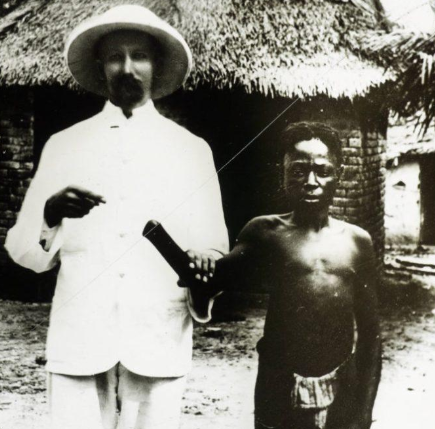
Force Publique soldiers were given a chilling standing order: for every cartridge expended, soldiers must produce a severed human hand as proof that the bullet had been used to kill a person, not wasted. This single bureaucratic rule would produce the most horrifying images in colonial history.
7. The Severed Hands — Symbol of the Congo Horror
The severed hand policy began as military accounting. It became something far darker.
Soldiers quickly discovered it was easier to cut hands from living people than to fight in the forest. Villages behind on their rubber quotas were raided. Hands were cut from men, women, and children — as punishment, as demonstration, as proof of power. Baskets of hands — smoked and dried to prevent decomposition — arrived at trading stations as evidence of military activity.

Historical documentation photograph from the Congo Free State era. Missionaries like Alice Seeley Harris systematically photographed the atrocities Leopold’s agents committed across the territory. (Public domain / Internet Archive)
The most devastating photograph was taken by missionary Alice Seeley Harris in 1904. It shows a Congolese man named Nsala of Wala sitting before the severed hand and foot of his five-year-old daughter Boali — the only remains left after Force Publique soldiers raided his village for failing to meet its rubber quota. The rest of his family had been killed and eaten.
When this photograph was published in European and American newspapers, it became one of the earliest examples in history of a single image causing a massive shift in public opinion. It is considered one of the first viral photographs ever taken.
“The baskets of smoked hands set down before each white man… how many hands had gone into that basket?”
— Edmund Morel, Congo reform campaigner and journalist, 1904
8. Women, Children, and Hostages
The severed hand was the most visible symbol of Congo atrocity, but the Force Publique operated many other systems of terror. When a village fell behind on its quota, soldiers arrived and took women and children as hostages — held, sometimes chained, at Force Publique posts until the men returned with enough rubber.
Hostages were held in appalling conditions with little food or water. Women were frequently subjected to sexual violence. Children died of disease and starvation in captivity. Villages that persistently failed to meet quotas were burned to the ground, crops were destroyed, and in some areas entire communities were massacred as an example to neighboring villages.
Farming was neglected as all labor went into rubber harvesting. Food production collapsed. Famine spread through the forest. And the rubber continued to flow to Antwerp, where it was sold at enormous profit.
9. The Death Toll: How Many Actually Died?
Establishing an exact death toll is impossible — Leopold ordered the systematic destruction of the colonial archives before relinquishing control. What we know is devastating: the Congo basin population was estimated at 20 to 30 million people in the 1880s. The first comprehensive Belgian census in 1924 counted approximately 10 million. The population had been cut in half in less than 40 years.
| 10M+ Estimated deaths 1885–1908 |
50% Population collapse in worst regions |
23yr Duration of Leopold’s personal rule |
$1B+ Profit extracted (modern equivalent) |
The historian Adam Hochschild, whose 1998 book King Leopold’s Ghost brought this history to mass audiences, estimates the death toll at approximately 10 million people. Other historians place the figure higher. Deaths came from direct killing, starvation, disease, and dramatically reduced birth rates in communities living under sustained terror.
10. The Whistleblowers: Morel, Casement, and Harris

The campaign that ended Leopold’s rule was not led by governments. It was led by three remarkable individuals who built the world’s first international human rights movement from nothing.
E.D. Morel — a Liverpool shipping clerk — noticed that ships to the Congo carried only guns and ammunition, never trade goods. This was not trade. It was theft enforced at gunpoint. He resigned his job and campaigned for years, building the Congo Reform Association in 1904.
Roger Casement — a British diplomat — was sent to the Congo to investigate in 1903. His report, published by the British government in 1904, was a masterpiece of careful documentation — naming specific officers, specific villages, specific incidents. It was impossible to dismiss as rumor.
Alice Seeley Harris — a British missionary — brought a camera. Over several years she photographed victims, survivors, and the aftermath of raids. Her photographs gave the reform movement what written reports could not: undeniable visual proof that was exhibited in churches and meeting halls across Britain and America.
11. How the World Finally Found Out — Timeline
12. Leopold’s Cover-Up: The Burning Archives
Leopold mounted a sophisticated and well-funded counter-campaign — anticipating modern propaganda techniques by a century. He hired American PR agents to plant favorable stories in newspapers. He created a “Commission for the Protection of Natives” that met once, achieved nothing, and existed solely for positive headlines. His agents questioned the authenticity of missionary photographs.
His most significant act came in 1908, as the Belgian parliament moved toward annexation. Leopold ordered the systematic destruction of the entire Congo Free State administrative archive. For three days, the furnaces of the Congo Free State’s Brussels headquarters burned continuously. Decades of records — rubber quotas, punishment orders, massacre reports, profit calculations — turned to ash.
“I will give them my Congo, but they have no right to know what I did there.”
— Attributed to King Leopold II, 1908
Leopold died on December 17, 1909 — one year after losing the Congo. He died one of the wealthiest men in Europe, having transformed Congo rubber into palaces, parks, and monuments across Belgium. He was given a state funeral with full honors. A statue of him still stands in Brussels today.
13. The Long Shadow: Congo Today

Historical photograph from colonial Congo. The legacy of the Congo Free State continues to shape the Democratic Republic of Congo more than a century later. (Public domain / Internet Archive)
Belgian colonial rule continued until 1960. When Congo finally achieved independence, it was left with one of the world’s least-developed infrastructures despite enormous mineral wealth: gold, diamonds, cobalt, and coltan — essential for the smartphones and electric vehicles we use today.
The DRC has been wracked by civil war, dictatorship, and foreign interference for most of its post-independence history. Since the mid-1990s, conflicts in eastern Congo have killed an estimated 5 to 6 million more people — driven largely by competition over the same mineral wealth that drew Leopold’s attention over a century ago.
Belgium formally expressed regret in June 2020, when King Philippe sent a letter to DRC President Félix Tshisekedi expressing “deepest regrets” for the colonial period. It was the first such statement by a Belgian head of state. No reparations have been paid. Statues of Leopold II across Belgium were vandalized and torn down during 2020 protests. Debates about what Belgium owes the Congo continue.
14. Why This Story Still Matters
The Congo Free State is not merely a dark chapter in Belgian history. It is a case study in the full anatomy of how atrocity happens — and how it is forgotten.
It happened because international institutions created legal frameworks that excluded the voices of the people they most affected, then called themselves civilized. It happened because governments across Europe and America chose profit and diplomatic convenience over justice.
It ended because ordinary people — a shipping clerk, a diplomat, a missionary with a camera — built an international movement from nothing, without funding or government support, before the concept of “human rights” even existed as a legal framework.
And then it was largely forgotten. Leopold II does not occupy the same cultural space as other architects of mass death. That forgetting is not an accident — it is the final success of Leopold’s propaganda. Learning this history clearly, facing it honestly, naming what it was — is the minimum that truth requires.
15. Frequently Asked Questions
❓ Was the Congo Free State a genocide?
The legal definition of genocide requires proof of intent to destroy a group “as such.” Leopold’s primary motivation was economic — he wanted rubber and profit. For this reason many historians describe it as a crime against humanity rather than genocide in the strict legal sense. Others argue the scale and systematic racial nature of the violence qualifies it. What is not in debate is the scale: between 10 and 15 million deaths.
❓ Did Belgium benefit from Leopold’s Congo wealth?
Yes, significantly. Leopold used Congo rubber profits to fund major public works across Belgium — parks, palaces, museums, and urban development projects. The AfricaMuseum in Tervuren was built entirely with Congo money. When Belgium took over the Congo in 1908, it inherited the ongoing economic benefits of colonial extraction until independence in 1960.
❓ Is Heart of Darkness based on the Congo Free State?
Yes. Joseph Conrad traveled the Congo River in 1890 as a steamship captain and was deeply disturbed by what he witnessed. Heart of Darkness (1899) drew directly on this experience. The novella is praised for its critique of colonialism but has also been criticized by writers like Chinua Achebe for reproducing colonial stereotypes in its portrayal of Africans.
❓ What happened to Congo after Leopold?
Belgium administered the Congo until independence in 1960. The transition was abrupt — Belgium had trained fewer than 30 Congolese university graduates. The first Prime Minister Patrice Lumumba was overthrown and assassinated within months, partly with CIA involvement. The country endured Mobutu’s 32-year dictatorship, two catastrophic civil wars, and ongoing conflict in the east that continues today.
❓ Has Belgium apologized?
In June 2020, Belgian King Philippe sent a letter to DRC President Tshisekedi expressing “deepest regrets” for the suffering caused during the colonial period — the first time a Belgian head of state had formally done so. This stopped short of a full state apology. No reparations have been proposed or paid.
❓ Where can I learn more?
Adam Hochschild’s King Leopold’s Ghost (1998) is the definitive popular history — essential reading. Roger Casement’s 1904 Congo Report is available online. E.D. Morel’s Red Rubber (1906) is available free on Project Gutenberg. The Internet Archive maintains a large collection of public domain photographs and documents from the Congo Free State era at archive.org.