The True Story Behind Antarctica’s Most Haunting Mystery
Across the endless white silence of Antarctica, something strange happens.
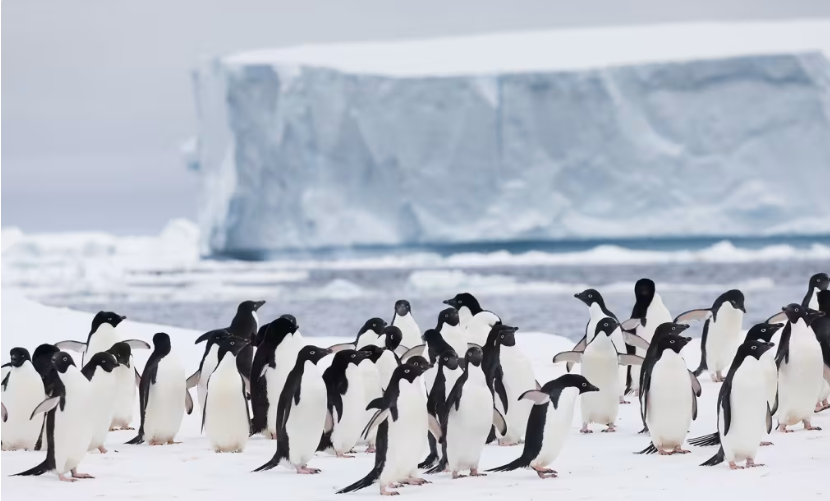
In a colony filled with thousands of penguins, one bird suddenly stops.
It turns away from the ocean, the only place where food and life exist.
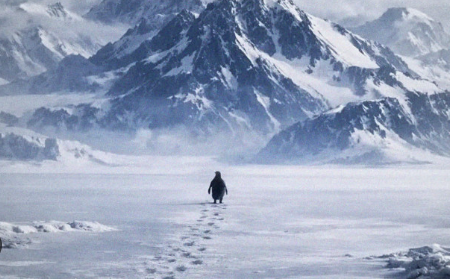
Then it begins walking, slowly and steadily, toward distant frozen mountains nearly 70 kilometers away.
There is no panic.
No sound.
Only a small dark figure moving alone through an empty world of ice.
When filmmaker Werner Herzog captured this moment, he asked a simple question that still echoes today:
But why?
Why would a creature built for survival choose isolation?
Why walk away from life toward certain death?
This mystery has stayed with millions of people, not just because of the penguin, but because of what it reveals about us.
A Break in Nature’s Perfect System
Penguins are among the strongest survivors on Earth.
Their lives depend on community. They gather in tight groups called huddles to protect each other from brutal Antarctic winds.
The colony means warmth, safety, and survival.
The ocean means food and life.
So when a penguin walks in the opposite direction, it feels impossible.
Scientists explain this behavior as disorientation or neurological error.
Something in the bird’s internal navigation fails.
But human hearts see something else.
We see a quiet rebellion.
A silent decision to leave the crowd.
A lonely journey filled with strange purpose.
The haunting part is not that the penguin is lost.
It is that the penguin walks with complete calm, never looking back.
Why This Story Feels So Personal
People around the world cannot forget this scene because it mirrors human life.
Today we live surrounded by noise, pressure, and constant connection.
We are always part of a social “huddle” filled with expectations, deadlines, and comparisons.
Watching the lone penguin awakens something hidden inside us.
We remember moments of deep exhaustion.
Times when the common path felt unbearable.
Moments when silence felt more healing than success.
The penguin becomes a symbol of:
- Quiet burnout
- The search for peace
- The courage to walk alone
Sometimes the wrong direction is the only path that feels honest.
Science Says Tragedy. The Heart Sees Meaning.
From a scientific view, the penguin’s journey ends in death.
There is no food in the mountains.
Only ice, wind, and emptiness.
Experts explain that even if humans return such penguins to the sea, they often turn around and walk back toward the interior again.
Their internal compass is broken.
Yet people resist calling the penguin “broken.”
We want to believe the journey holds meaning.
We want to believe the penguin found a kind of freedom the colony never knew.
This conflict between science and emotion is what makes the story unforgettable.
The Strange Peace of Absolute Silence
Antarctica represents something rare in the modern world:
total stillness.
No competition.
No deadlines.
No human noise.
The empty horizon feels almost spiritual.
The walking penguin becomes a symbol of intentional solitude.
It reminds us that strength is not always staying with the group.
Sometimes strength is facing the unknown alone.
And sometimes silence heals what survival cannot.
So… Why Did the Penguin Walk Away?
Science may never give a satisfying emotional answer.
But the human heart offers possibilities.
Maybe the penguin followed a broken compass.
Maybe it followed instinct beyond understanding.
Or maybe, in a way we cannot explain, it followed peace.
The lonely walk across Antarctica reflects our own hidden endurance.
It teaches that life is not only about surviving.
Sometimes it is about dignity, silence, and choosing a path no one else understands.
The Real Story Behind the Footage
The famous scene comes from the 2007 documentary Encounters at the End of the World, filmed in Antarctica.
In the film:
- A lone Adélie penguin leaves its colony at New Harbor
- It walks toward distant mountains far from the sea
- Experts describe the behavior as rare disorientation
Years later, the clip resurfaced online and went viral again, where many people called it the “Nihilist Penguin.”
For a generation facing stress, burnout, and uncertainty, the image felt deeply relatable.
Final Thoughts
Nature does not always explain itself in clear language.
Sometimes it tells quiet stories instead.
The penguin walking toward the mountains is one of those stories.
A story about loneliness.
About freedom.
About the strange beauty of choosing silence.
And maybe that is why we cannot look away.
Because somewhere inside,
we understand the question:
But why?
References & Sources
Documentary Evidence
- Encounters at the End of the World directed by Werner Herzog
This award-nominated Antarctic documentary contains the original footage of a lone Adélie penguin walking away from its colony toward the interior ice. Herzog’s narration introduced the haunting question, “But why?”, which later shaped global discussion around the scene.
Scientific Research on Adélie Penguin Behavior
- Work by David G. Ainley, Antarctic ecologist and seabird expert
Ainley explains that rare inland wandering in penguins is most likely caused by navigation disorientation or neurological malfunction, not intentional behavior.
Key book: The Adélie Penguin: Bellwether of Climate Change (Columbia University Press).
Environmental Protection Laws in Antarctica
- Governed under the Antarctic Treaty System
The treaty strictly prohibits unnecessary human interference with wildlife.
Because of these protections, researchers and filmmakers observing the lone penguin could not redirect or rescue it.
Cultural Resurgence in the Digital Era
- Viral circulation on TikTok and X
Online audiences reframed the footage as the “Nihilist Penguin,” linking the imagery to modern themes of burnout, isolation, and existential reflection in contemporary life.