Black holes are among the most fascinating and mysterious objects in the universe. From popular movies to cutting-edge astrophysics, they capture human imagination like few other cosmic phenomena. But despite decades of research, much about black holes remains unknown. One of the most compelling questions is: what actually lies inside a black hole? Or as astrophysicists might ask, “inside a black hole – what really exists?”
In this article, we will explore black holes in depth, covering everything from their formation and anatomy to the bizarre physics that governs them. By the end, you will have a clear understanding of black holes, their secrets, and why they are key to unraveling the mysteries of the universe.
What Is a Black Hole?
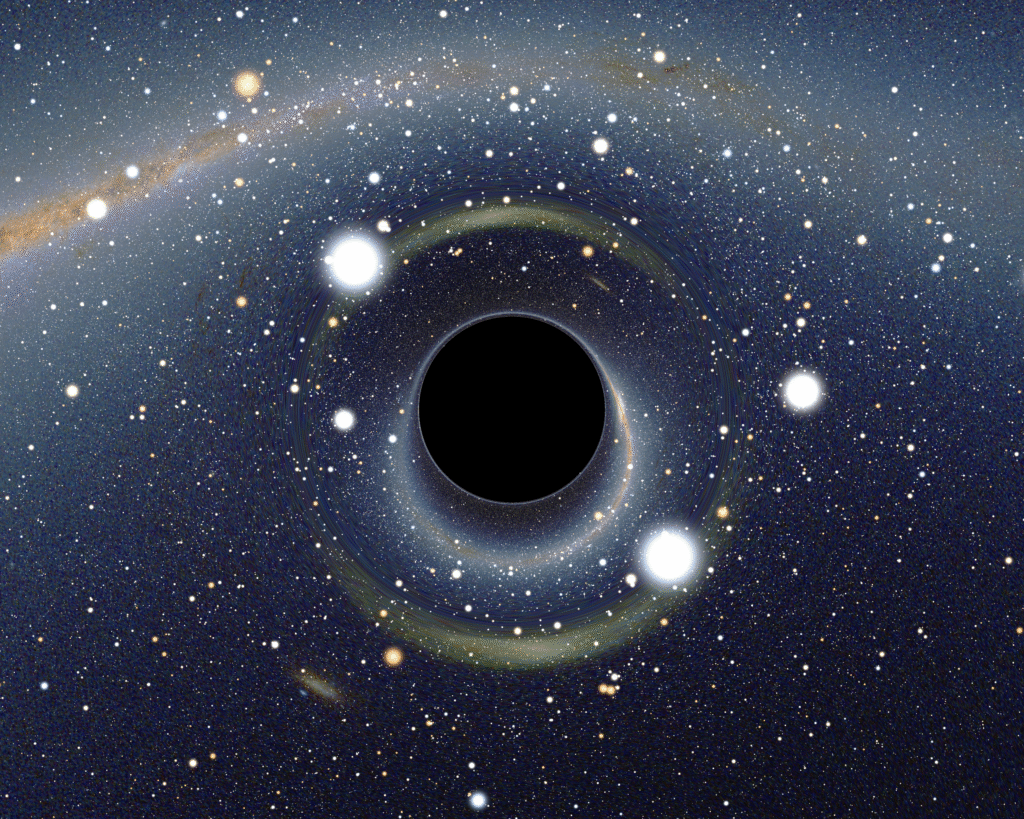
A black hole is a region in space where gravity is so strong that nothing, not even light, can escape it. They are invisible to the naked eye, which makes detecting and studying them a complex task. Scientists rely on indirect observations, such as monitoring the behavior of nearby stars or detecting the X-rays emitted from matter falling into the black hole.
How Gravity Creates a Black Hole
Black holes are born from gravity’s relentless pull. When a massive star runs out of nuclear fuel, it can no longer resist the force of gravity. Its core collapses, compressing matter into an incredibly dense point. If the remaining mass is sufficient, this collapse results in a black hole.
Anatomy of a Black Hole
Understanding what’s inside a black hole is one of astrophysics’ greatest challenges. Black holes are not uniform—they have distinct regions with unique properties.
1. Event Horizon – The Point of No Return
The event horizon is the boundary surrounding a black hole. Once an object crosses this line, it cannot escape. It is not a physical surface but a conceptual one, defined by the point at which escape velocity equals the speed of light.
- Analogy: Imagine a waterfall: once you pass the edge, there’s no turning back.
- Importance: Determines the black hole’s observable size, also known as the Schwarzschild radius.
2. Singularity – Where Physics Breaks Down
At the heart of a black hole lies the singularity—a point of infinite density where the curvature of space-time becomes infinite. Here, gravity is so strong that our current understanding of physics collapses.
- General relativity predicts the singularity.
- Quantum mechanics suggests new phenomena may occur at this scale.
- Scientists are still debating what happens at the singularity, making it one of the universe’s greatest mysteries.
3. Accretion Disk – The Glowing Ring Around Darkness
Many black holes are surrounded by a disk of gas, dust, and stellar debris called the accretion disk. Matter spirals inward, heating up due to friction and emitting X-rays and gamma rays.
- Detection: This glowing disk is how astronomers often infer a black hole’s presence.
- Visual: Imagine a whirlpool of matter glowing with extreme energy as it falls toward the void.
4. Relativistic Jets
Some black holes emit jets of charged particles at nearly the speed of light, stretching thousands of light-years into space. These are produced by the interaction of the accretion disk and the black hole’s magnetic field.
Physics Inside a Black Hole
Falling into a black hole is purely theoretical, but physics predicts several extreme effects:
Spaghettification
As an object approaches a black hole, gravity stretches it lengthwise while compressing it widthwise, creating a “spaghetti-like” shape. This is due to the tidal forces caused by gravity’s difference across the object’s length.
Time Dilation
Einstein’s general relativity predicts that time slows down near a black hole. For someone falling into a black hole, time appears to pass normally, but an external observer would see their fall slow dramatically, almost freezing at the event horizon.
Breaking of Physics Laws
Inside the singularity, known laws of physics no longer apply. Concepts of space, time, and matter may behave in ways that are currently unimaginable. Quantum gravity may eventually provide answers, but this remains one of science’s greatest unknowns.
Mysteries and Theories of Black Holes
Black holes are not just fascinating—they are laboratories for extreme physics. Several theories attempt to explain their mysteries:
Wormholes – Cosmic Shortcuts
Some theorists suggest black holes could connect distant parts of the universe, forming tunnels in space-time called wormholes. These remain hypothetical but inspire both scientific and science fiction discussions.
White Holes – Theoretical Opposites
White holes are predicted to expel matter rather than absorb it. They could, in theory, be the reverse of black holes, although no observational evidence currently exists.
Hawking Radiation
Stephen Hawking proposed that black holes are not entirely black. Quantum effects near the event horizon can cause them to emit radiation, slowly losing mass and potentially evaporating over astronomical timescales.
Information Paradox
A key question is: what happens to information that falls into a black hole? This paradox challenges the fundamental principles of quantum mechanics and general relativity and is still unresolved.
Famous Black Holes in the Universe
- Sagittarius A* – The supermassive black hole at the center of the Milky Way.
- M87* – The first black hole ever directly imaged by the Event Horizon Telescope.
- Cygnus X-1 – One of the first stellar black holes discovered.
- Ton 618 – An ultramassive black hole with billions of solar masses.
Studying these objects has provided unprecedented insights into galaxy formation, gravity, and the extreme universe.
Why Studying Black Holes Matters
Studying black holes is not just an academic exercise. It helps humanity understand:
- The limits of general relativity and quantum physics
- How galaxies and stars evolve
- The nature of dark matter and dark energy
- The origins and ultimate fate of the universe
Black holes are natural laboratories for testing physics in extreme conditions, far beyond what can be replicated on Earth.
Black Holes in Popular Culture
Black holes have inspired countless movies, books, and documentaries. Films like Interstellar attempt to visualize black holes based on scientific models, helping the public understand these cosmic giants. While dramatized, such media brings black hole science to a wider audience and fuels curiosity for learning.
FAQs About Black Holes
Q1: Can we see a black hole?
- Not directly, but we detect them via accretion disks, gravitational lensing, and their effect on nearby stars.
Q2: What’s inside a black hole?
- The singularity—a point of infinite density—lies at the core, surrounded by the event horizon.
Q3: Can black holes destroy planets?
- Only if they come extremely close. Earth is far from any black hole that poses a threat.
Q4: Do black holes last forever?
- Hawking radiation suggests they may eventually evaporate, but over billions of years.
Conclusion – The Secrets of Black Holes Revealed
Black holes are not just cosmic vacuum cleaners; they are gateways to understanding the universe itself. From the event horizon to the singularity, black holes challenge our understanding of space, time, and physics. By studying them, we unlock secrets about gravity, galaxy formation, and even the fundamental nature of reality.
So, “inside a black hole – andar hota kya hai?” The answer: a singularity of infinite density, bending space-time beyond recognition, surrounded by an event horizon where nothing escapes. Black holes remain one of the universe’s most profound mysteries—part scientific enigma, part cosmic wonder.
References
- Hawking, S. (1974). Black hole explosions? Nature, 248(5443), 30–31.
- Thorne, K. (1994). Black Holes and Time Warps: Einstein’s Outrageous Legacy. W.W. Norton & Company.
- Einstein, A. (1916). The Foundation of the General Theory of Relativity. Annalen der Physik, 49, 769–822.
- Event Horizon Telescope Collaboration. (2019). First M87 Black Hole Image. The Astrophysical Journal Letters, 875(1), L1.
- NASA. Black Holes Explained. https://www.nasa.gov/black-holes
- Misner, C.W., Thorne, K.S., & Wheeler, J.A. (1973). Gravitation. W.H. Freeman.
Image Credit: Wikimedia Commons (CC BY-SA 4.0)