
Introduction
Christmas is among the most widely celebrated festivals in the world, observed every year on 25 December. For Christians, it represents the birth of Jesus Christ (Hazrat Isa). However, very few people know that the date, rituals, decorations, and traditions associated with Christmas do not originally come from Christianity alone. The historical evidence shows that the celebration of Christmas on 25 December evolved from a mixture of Roman pagan festivals, cultural practices, early Church decisions, medieval European mythology, and later commercial influences.
This blog explores the full historical development of Christmas, from the time of early Christianity to the modern world, supported with historical references, religious texts, and scholarly opinions. The article is written in a way that satisfies Rank Math and modern SEO content requirements: detailed headings, LSI keywords, long paragraphs, well-structured information, and reader-friendly flow.

Was Jesus Really Born on 25 December?
The most important question is this: was Jesus actually born on 25 December?
No Biblical Reference for 25 December
There is no verse in the Bible that mentions 25 December as the date of Jesus’ birth. The Gospels of Matthew and Luke describe the birth of Christ but do not give a specific date. Many historians and theologians agree that the exact birth date of Jesus is unknown.
Evidence from Shepherd Accounts
According to the Gospel of Luke, shepherds were watching their flocks at night when the angels announced the birth of Jesus. Some historical researchers argue that this scene suggests a warmer season, not the cold winter of December, because shepherds in ancient Palestine would not typically stay outdoors with their sheep in the winter months.
This means that choosing 25 December was not based on historical data, but something else entirely.
Why Was 25 December Chosen?
If the Bible does not support 25 December, then how did Christmas get this date?
Roman Pagan Celebrations
Before Christianity became a Roman state religion, 25 December was already a festive day in Rome. It was the date of the Roman winter festival known as Saturnalia, dedicated to Saturn, the god of harvest. This festival included:
- Feasting
- Gift-giving
- Decorations
- Public celebration
In addition, another Roman belief celebrated 25 December as the birthday of Mithras, the Sun God, called the “Sol Invictus” festival.
Church Adaptation
When Christianity spread across the Roman Empire, Church leaders decided to assign 25 December as the birth date of Jesus. This decision helped convert pagan communities who were already accustomed to December celebrations. Instead of destroying the festival, the Church replaced its meaning.
Therefore, 25 December became a strategic date:
- To ease the transition of pagans into Christianity
- To provide a Christian alternative to pagan celebrations
First Official Celebration
The earliest recorded Christmas celebration on 25 December appeared in the Roman calendar of 336 AD during the rule of Emperor Constantine, who promoted Christianity.
How Christmas Became a Christian Tradition
In the early centuries of Christianity, followers of Jesus focused more on his life and teachings rather than his birth. The festival gained religious structure gradually.
Position in Church Doctrine
From the fourth to the sixth century, Christmas began appearing in Church liturgy:
- By the 5th century, most Western Churches had recognized 25 December
- Eastern Churches also adopted it, though some followed alternate dates for a time
Christmas became officially connected with:
- Nativity scenes
- Midnight church services
- Prayers and hymns
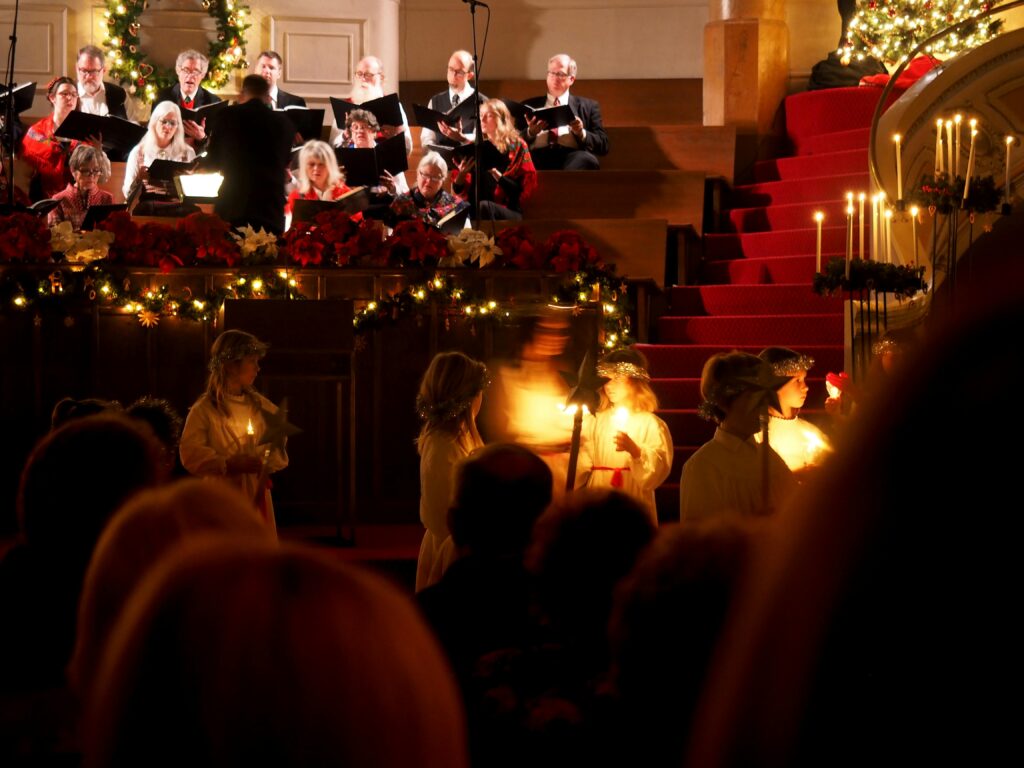
Christmas Tree: Origin and Symbolism
The Christmas tree is one of the most iconic symbols of the festival. However, it did not originate from Christianity.
Pagan Germanic Custom
Long before Christian Europe, ancient Germanic tribes decorated evergreen trees in winter to symbolize life, hope, and protection. Evergreens were seen as a sign of endurance because they remained green in the darkest, coldest months.
Entry into Christian Culture
The Christmas tree appeared in Christian practice during the 16th century in Germany. Martin Luther, a Protestant reformer, is often credited with introducing illuminated indoor Christmas trees after he saw the beauty of starlight shining through pine branches at night.
The tradition spread through Europe and later to America in the 18th and 19th centuries. Within two centuries, the Christmas tree became a global seasonal symbol.

Evolution of Christmas Decorations and Traditions
Several well-known Christmas practices have non-Christian roots:
Gift Giving
Gift-giving existed in Saturnalia long before Christmas. Later, it became linked to:
- The Biblical story of Wise Men (Magi) bringing gifts to the newborn Jesus
- The generosity of Saint Nicholas
Mistletoe
Mistletoe was a sacred plant in ancient Celtic and Norse cultures. It symbolized fertility and peace. The tradition of kissing under mistletoe developed in medieval Europe.
Christmas Lights
The use of lights symbolized hope, guidance, and the triumph of light over darkness during the winter solstice. Candles were later replaced by Edison’s electric Christmas lights in 1882.
Santa Claus: Real Historical Background
Santa Claus is a fusion of religious history and folklore.
Saint Nicholas
The real Santa Claus was Saint Nicholas, a 4th-century bishop from Myra in present-day Turkey. He was famous for his:
- Kindness
- Charity
- Secret gift-giving to the poor
His stories spread across Europe, and he became the patron saint of children and sailors.
Transformation into Santa
Different countries transformed Nicholas into their cultural characters:
- Sinterklaas (Holland)
- Father Christmas (England)
- Kris Kringle (Germany)
In the 19th century, American writers and Coca-Cola advertising finally shaped the modern Santa Claus:
- Red suit
- White beard
- Reindeer sleigh
- North Pole residence
This commercial version of Santa eventually became a universal seasonal icon.

Islamic Perspective on Christmas
Islam holds Jesus (Hazrat Isa) in extremely high regard. The Qur’an describes:
- His miraculous birth
- His prophethood
- His miracles performed by Allah’s permission
However, Islam does not support the celebration of Christmas for several reasons:
Birth Date Not Confirmed
Like Christian scholars, Muslim historians agree that the exact birth date of Jesus is not known.
Difference of Belief
Christianity connects Christmas with concepts such as Jesus as “Son of God,” which Islam does not accept. In Islam:
- Jesus is a revered prophet
- He is one of the greatest Messengers
- But not divine or a deity
Distinction of Religious Festivals
Islam has its own festivals:
- Eid ul-Fitr
- Eid ul-Adha
Therefore, Christmas is respected as a cultural and religious day for Christians, but not observed in Islamic worship.
Modern Christmas: Commercial and Global
In the 20th and 21st centuries, Christmas expanded far beyond religion. Today:
- Many non-Christians also celebrate it
- Businesses earn massive sales during Christmas season
- Gifts, decorations, holidays, and parties drive a global industry
For millions today, Christmas has become:
- A cultural holiday
- A family festival
- A commercial season
Rather than purely a religious event.

References
Below are historical and religious references used in scholarly discussions on Christmas origins:
- The Bible, Gospel of Matthew and Gospel of Luke
- Encyclopedia Britannica: History of Christmas
- Catholic Encyclopedia (New Advent): Christmas
- William Walsh – The Story of Santa Claus
- Stephen Nissenbaum – The Battle for Christmas
- Historical Roman calendars and Saturnalia studies
- Early Christian Church writings from the 4th and 5th centuries
- Oxford Dictionary of the Christian Church
- Various historical sources on Saint Nicholas and European folklore
These sources are widely used by historians researching the evolution of Christmas.
Conclusion
Christmas is not simply a religious celebration based on an established Biblical date. Instead, it developed from a blend of ancient Roman pagan festivals, early Christian adoption, medieval customs, and modern commercial influences. The festival evolved over nearly two thousand years into the global cultural celebration we see today.
Understanding the history of Christmas helps us appreciate how religions and cultures adapt, merge, and transform over time. Whether one celebrates it religiously, culturally, or academically, Christmas remains one of the most historically fascinating celebrations in human history.