Introduction
Every year, the ID Week Conference gathers the world’s top infectious disease experts to discuss new medical challenges.
But ID Week 2025 in San Diego shocked everyone — because this year’s discussions pointed to a potential new global health threat.
From antibiotic resistance to virus evolution, scientists believe the next pandemic warning signs are already visible.
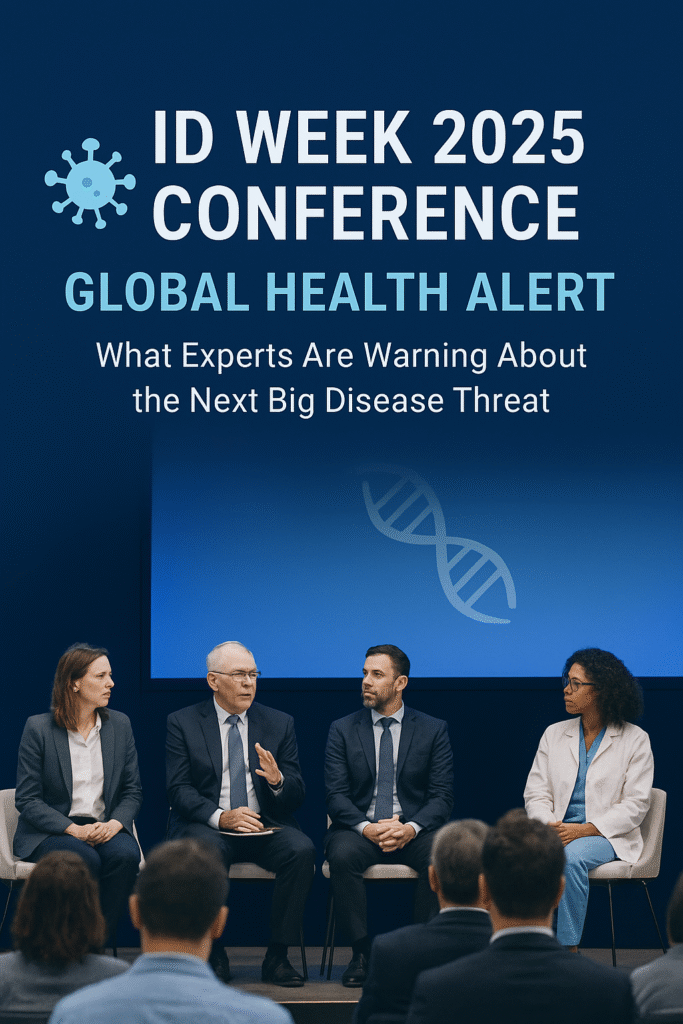
What Is ID Week and Why It Matters
ID Week (Infectious Diseases Week) is one of the most respected medical gatherings in the world.
It’s organized by groups like the Infectious Diseases Society of America (IDSA) and the HIV Medicine Association.
Researchers, doctors, and public health leaders share new studies, outbreak data, and prevention strategies.
The goal is simple — find the next disease before it finds us.
Key Discoveries from ID Week 2025
1. Antibiotic Resistance Is Escalating
According to a 2025 global report shared at the conference, over 1.5 million deaths each year are linked to antibiotic-resistant infections.
Scientists warned that drug-resistant bacteria like E. coli, Klebsiella, and Staphylococcus aureus are spreading faster than expected.
One top researcher said:
“Antibiotic resistance is not a future problem — it’s already here, and it’s our silent pandemic.”
2. The Rise of Animal-to-Human Viruses
Experts from the CDC and WHO presented new data on zoonotic viruses — infections that jump from animals to humans.
The conference revealed that global deforestation, illegal wildlife trade, and climate change are making such viruses more common and more deadly.
In 2025, a new bat-related virus (nicknamed “NeoCov-25”) was reported in Asia — though still under study, it reminded experts how fast new pathogens can appear.
3. Climate Change Is Fueling Outbreaks
Climate change isn’t just an environmental problem — it’s a disease multiplier.
Warming temperatures are expanding mosquito zones, leading to higher cases of dengue, malaria, and chikungunya in new regions.
A top WHO scientist at the event said:
“Where the climate changes, disease follows. The next outbreak might start where no one expects.”
4. AI in Disease Prediction
Another powerful trend at ID Week 2025 was the role of Artificial Intelligence in early outbreak detection.
AI models are now scanning millions of online reports, hospital records, and flight data to spot unusual disease clusters before humans even notice.
As one scientist noted,
“AI won’t replace epidemiologists, but it can warn them days — even weeks — earlier.”
What This Means for the Future
The discussions at ID Week 2025 make one thing clear:
The next big disease threat won’t come suddenly — it’s already forming silently in the background.
Better surveillance, global cooperation, and scientific transparency are our best defense.
The pandemic taught the world one thing — preparation saves lives.
Conclusion
The ID Week 2025 conference didn’t just highlight the problems; it offered hope through innovation, research, and awareness.
Whether it’s AI-driven health monitoring, global vaccine development, or stronger antibiotic policies —
the lessons from ID Week 2025 remind us that the next health crisis can be prevented, not just cured.