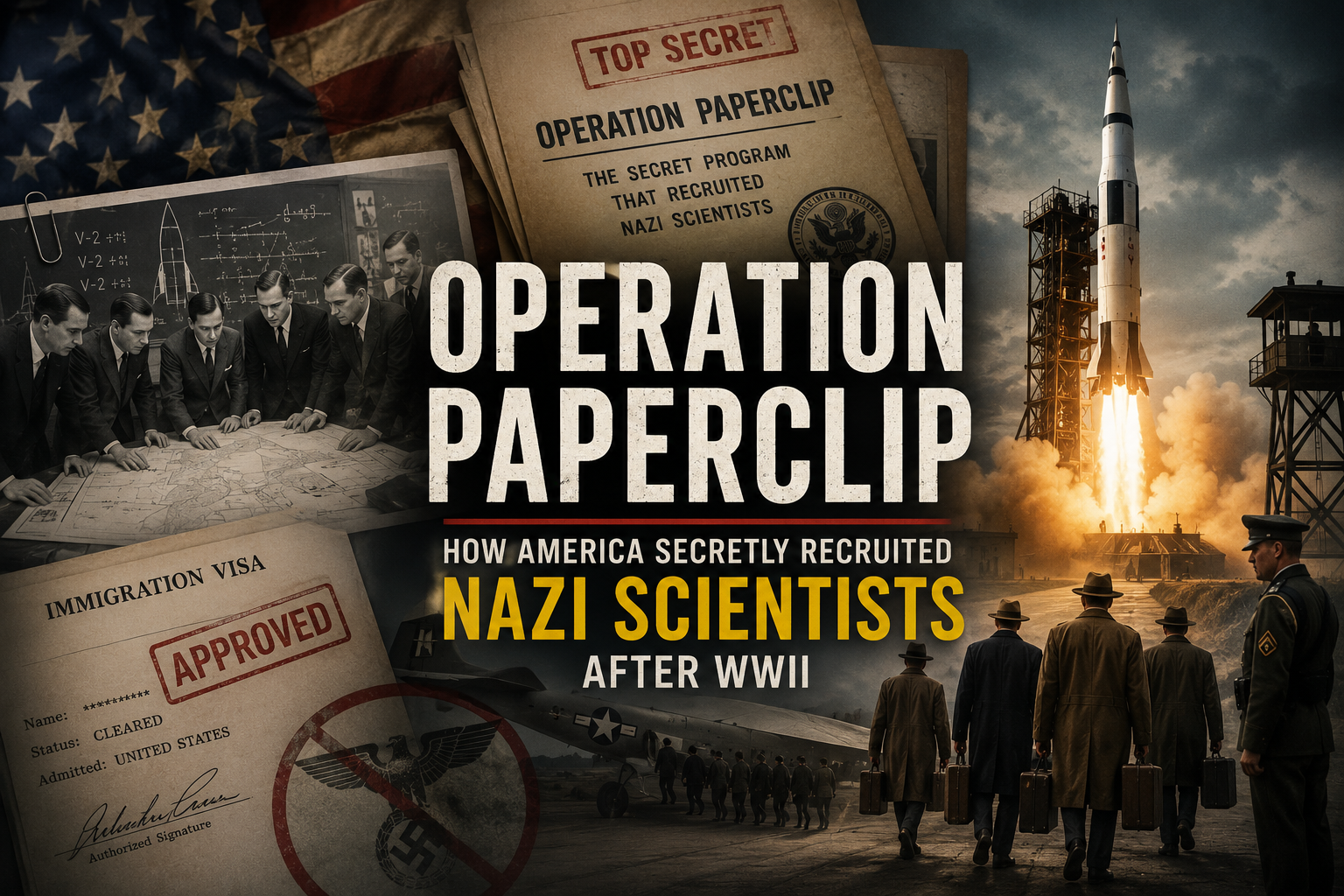
America spent four years and hundreds of thousands of lives defeating Nazi Germany. Then, before the ink on the surrender documents was dry, the United States government quietly recruited over 1,600 of Hitler’s most valuable scientists — men who had used slave labor, conducted experiments on concentration camp prisoners, and in some cases were directly responsible for mass murder. Their war crime records were falsified. Their Nazi Party memberships were erased. And they were brought to America, given security clearances, and handed the keys to the country’s most classified military and space programs. This is the complete story of Operation Paperclip.
| Updated: July 2026 | 22 Min Read | USA & Germany · 1945–1959 | Declassified Government Program |
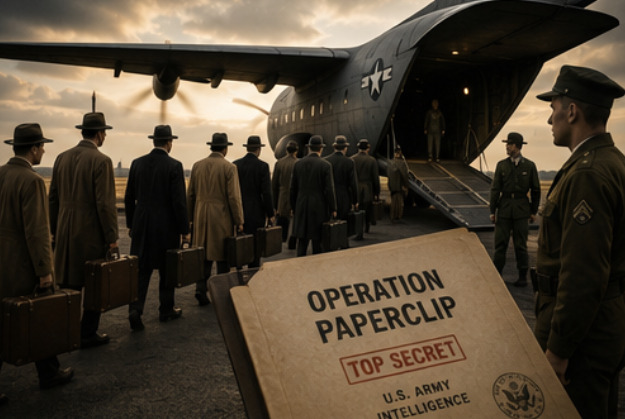
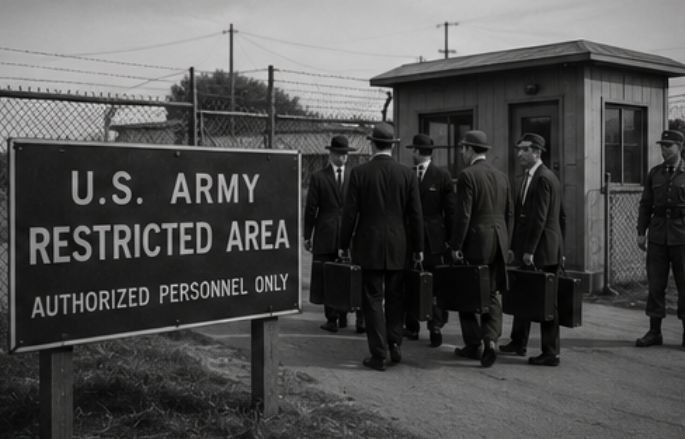
Operation Paperclip was a secret United States government program that recruited over 1,600 German scientists, engineers, and technicians from Nazi Germany after World War II. The program ran from 1945 to 1959. Participants’ Nazi Party memberships and war crime records were systematically falsified to allow their entry into the United States. (US National Archives / Public Domain)
On May 8, 1945, Nazi Germany surrendered unconditionally to the Allied powers. The war in Europe was over. The Nazi regime — responsible for the Holocaust, for the systematic murder of six million Jewish people and millions more, for a reign of terror that had consumed the continent for six years — was finished. The Nuremberg trials were being organized to hold its architects accountable. The world was, finally, beginning to reckon with what had been done in the name of the Third Reich.
Behind the scenes, the United States government was doing something else entirely. American military intelligence officers were racing across defeated Germany with lists of names — scientists, engineers, weapons designers, aerospace specialists, chemical warfare experts — that they needed to find before the Soviet Union did. These men had built Hitler’s V-2 rockets. They had developed Nazi chemical weapons. They had worked in factories powered by concentration camp slave labor. Some had personally overseen that labor. Some had conducted experiments on prisoners.
The program that recruited them was called Operation Paperclip. It was classified for decades. It brought over 1,600 German scientists to the United States between 1945 and 1959, falsifying their backgrounds to circumvent American immigration laws that barred former Nazis and war criminals from entry. The scientists of Operation Paperclip Nazi recruitment built America’s space program, its ballistic missile arsenal, its chemical and biological weapons capabilities, and its Cold War military technology. America won the Space Race partly on the backs of men who had won Hitler’s war on the backs of slave laborers.
☰ TABLE OF CONTENTS
- What Was Operation Paperclip? The Full Story
- The Cold War Race That Made It Happen
- How America Found and Recruited Nazi Scientists
- Falsifying the Records: How War Criminals Became American Heroes
- Wernher von Braun: The Rocket Man Who Built Slave Labor Factories
- Walter Schreiber: The Nazi Doctor the Air Force Hid
- Kurt Blome: The Biological Warfare Scientist Who Escaped Justice
- The Mittelwerk Factory: Built by Slave Labor, Powered by Death
- What the Scientists Built in America
- NASA and the Space Race: Operation Paperclip’s Greatest Legacy
- The State Department’s Objections — and Why They Were Overruled
- How Operation Paperclip Was Finally Exposed
- The Soviet Version: Operation Osoaviakhim
- The Moral Cost: What America Traded for Science
- Why Operation Paperclip Still Matters Today
- Frequently Asked Questions
1. What Was Operation Paperclip? The Complete Story of America’s Nazi Scientist Program
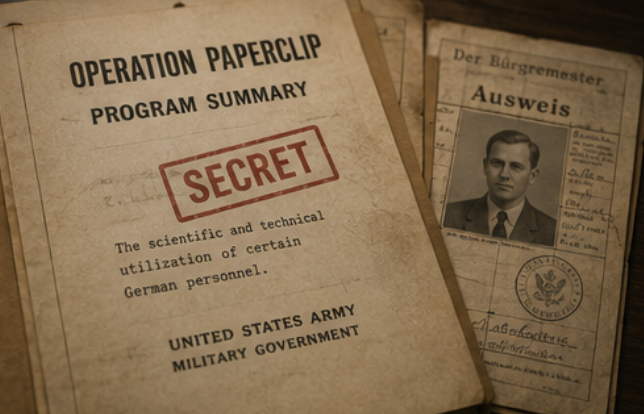
Operation Paperclip was a secret program of the United States Joint Intelligence Objectives Agency (JIOA), operating under the authority of the Joint Chiefs of Staff, that ran from 1945 to 1959. Its objective was to recruit German scientists, engineers, and technicians from the defeated Nazi state and bring them to the United States to work on American military and scientific programs. The name came from the paperclips used to attach favorable new biographical summaries to the files of scientists whose actual Nazi records would have disqualified them from entry.
Operation Paperclip Nazi scientists recruitment was authorized at the highest levels of the US government — President Truman signed the directive approving it, though with an explicit condition: no one who had been “a member of the Nazi Party and more than a nominal participant in its activities, or an active supporter of Nazi militarism” should be recruited. This condition was then systematically circumvented by the military officers running the program, who falsified dossiers, omitted Nazi Party membership records, and reclassified war criminals as ordinary scientists in order to bring in the people they wanted regardless of their backgrounds.
| 1,600+ Nazi scientists recruited |
14yr Program duration 1945–1959 |
100% Had Nazi records falsified |
0 Prosecuted for war crimes |
2. The Cold War Race That Made Operation Paperclip Possible
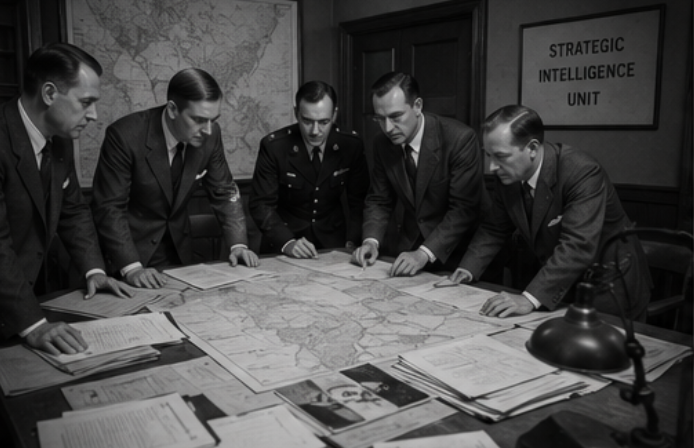
The decision to recruit Operation Paperclip Nazi scientists did not happen in a moral vacuum. It happened in the specific context of the emerging Cold War — a context in which American military and intelligence leadership genuinely believed that the Soviet Union posed an existential threat, and that winning the technological arms race against Soviet science was a matter of national survival.
Germany in 1945 represented the most advanced military scientific establishment in the world. German scientists had developed the V-2 rocket — the world’s first ballistic missile — the jet engine in operational military aircraft, advanced nerve agents including Tabun and Sarin, sophisticated submarine technology, and cutting-edge aerospace research. This knowledge did not disappear when Germany surrendered. It sat in the minds and notebooks of the scientists who had created it, in a defeated country now being occupied by both American and Soviet forces.
The race to capture this knowledge before the Soviets did was real and urgent. American military intelligence knew the Soviets were conducting their own recruitment operation — what would become known as Operation Osoaviakhim. The calculation made by American officials was simple and brutal: the scientific value of these men was worth more than the moral cost of protecting them from accountability for what they had done. That calculation has never been fully reckoned with.
3. How America Found and Recruited Operation Paperclip’s Nazi Scientists
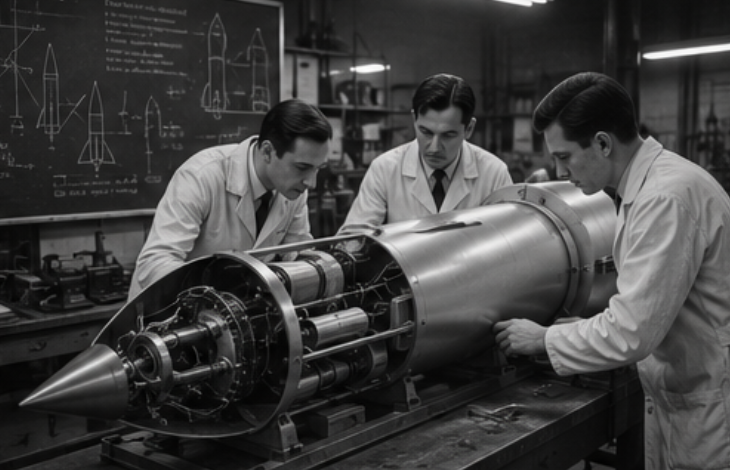
American military intelligence officers moved rapidly through defeated Germany in 1945, following target lists of scientists to locate and secure before Soviet forces could reach them. Many German scientists were discovered in the Bavarian Alps, where they had retreated with their research in the final months of the war. Over 1,600 were eventually brought to the United States under Operation Paperclip. (US National Archives / Public Domain)
The recruitment operation for Operation Paperclip began before the German surrender was even signed. American military intelligence units called T-Forces — specially tasked with capturing enemy scientific and technical intelligence — moved through Germany with detailed target lists, seizing documents, equipment, and scientists. They followed the Nazi research apparatus as it collapsed, tracking scientists who had retreated with their work to the Bavarian Alps in the final weeks of the war.
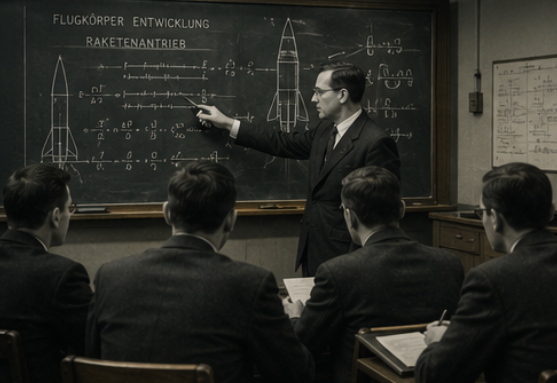
One of the most significant early captures was a group of rocket scientists at Peenemünde — the Baltic Sea facility where Germany had developed the V-2 — who surrendered themselves to American forces rather than be captured by advancing Soviet troops. They included Wernher von Braun, the program’s technical director, and over 100 of his key associates. They came with 14 tons of V-2 technical documents that they had hidden in a salt mine, and 100 V-2 rockets that American forces captured intact.
The scientists were initially housed at Fort Bliss, Texas and White Sands Proving Ground in New Mexico — technically as “prisoners of peace,” under military custody but with significant freedom of movement. Their families were eventually brought over from Germany. Over time, as the Operation Paperclip program formalized and expanded, the scientists were integrated into American military research facilities, universities, and eventually NASA.
4. Falsifying the Records: How Nazi War Criminals Became American Security Assets
The most damning aspect of Operation Paperclip — the aspect that transforms it from a morally ambiguous Cold War necessity into something clearly criminal — is the systematic falsification of the scientists’ records. President Truman’s directive explicitly prohibited the recruitment of active Nazis and those who had participated in war crimes. The military officers running the program simply ignored this directive by falsifying the evidence.
The JIOA created new biographical summaries — attached to original files with paperclips, hence the program’s name — that omitted or minimized Nazi Party membership, described men who had overseen slave labor programs as “apolitical,” characterized those who had joined the SS as having done so under duress, and in some cases simply left blank the sections of immigration paperwork that asked about war crimes. The State Department objected repeatedly. The military overruled the State Department repeatedly. The scientists came anyway.
Author Annie Jacobsen, whose 2014 book Operation Paperclip remains the definitive account, documented this process in granular detail using declassified government files. She found that the JIOA systematically reviewed each scientist’s file, identified the elements that would trigger disqualification, and then altered or suppressed those elements. This was not the judgment of individual officers. It was institutional policy, documented in official memoranda, to falsify records in order to import men who had committed war crimes into the United States.
“It seems to me that in this instance we are being asked to act in violation of our basic American principles. We are under no obligation to give these men an opportunity to become American citizens.”
— Samuel Klaus, State Department official, internal memo objecting to Operation Paperclip, 1946 — his objections were overruled by the Joint Chiefs of Staff
5. Wernher von Braun: The Rocket Man Who Built Missiles on Slave Labor
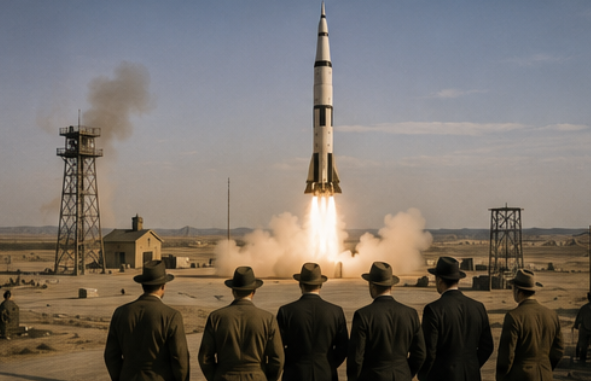
Wernher von Braun — the most famous Operation Paperclip recruit, and ultimately the director of NASA’s Marshall Space Flight Center and chief architect of the Saturn V rocket that took Americans to the Moon. He was also an SS officer, a Nazi Party member, and a man who visited the Mittelwerk factory where V-2 rockets were built by concentration camp prisoners who died by the thousands. (NASA / Public Domain)
No figure better embodies both the achievement and the moral corruption of Operation Paperclip than Wernher von Braun. He is one of the most celebrated figures in American space history — the brilliant engineer who led the development of the Saturn V rocket, who stood beside President Kennedy when he committed America to reaching the Moon, who became the public face of American space ambition. He is also an SS officer, a committed Nazi Party member, and a man whose greatest wartime achievement was built on the bodies of concentration camp prisoners.
Von Braun joined the Nazi Party in 1937 and the SS in 1940 — membership he would later claim was coerced. He served as technical director of the Peenemünde V-2 program, which produced the ballistic missiles that killed approximately 9,000 people in Britain and Belgium and another 12,000 forced laborers who died building them. He visited the Mittelwerk underground factory — where V-2 rockets were assembled by prisoners from the Dora concentration camp under conditions of extreme brutality — on multiple documented occasions. Whether he was aware of the full extent of the deaths is debated. Whether he benefited from the slave labor and continued the program while the deaths mounted is not.
Von Braun’s Operation Paperclip dossier described him as “not an ardent Nazi” and his SS membership as nominal. His actual record — a committed party member who had risen to the rank of SS-Sturmbannführer (equivalent to major) — was suppressed. He was brought to Fort Bliss, eventually moved to Huntsville, Alabama, and ultimately became the director of NASA’s Marshall Space Flight Center, where he designed the rocket that put Americans on the Moon in 1969. The Saturn V rocket — America’s greatest technological achievement — was designed by an SS officer whose previous rocket had been built by slave labor.
“I aim at the stars. Sometimes I hit London.”
— Satirical verse about Wernher von Braun, written by comedian Mort Sahl, capturing the dark contradiction at the heart of von Braun’s celebrated American career
6. Walter Schreiber: The Nazi Doctor America Tried to Hide in Plain Sight
Not every Operation Paperclip story ends with a Moon rocket. Some end in ways that are simply horrifying. Walter Schreiber was a German Army Surgeon General who had overseen medical experiments on concentration camp prisoners at Ravensbrück. These experiments included deliberate infection of prisoners with gas gangrene, tetanus, and other pathogens, testing surgical wound treatments on people who had been intentionally wounded without their consent, and high-altitude experiments that killed prisoners through oxygen deprivation.
Schreiber had testified at the Nuremberg Doctors’ Trial — as a prosecution witness against other Nazi doctors. This testimony gave him a degree of protection, and American intelligence used it as justification to characterize him as a cooperative asset rather than a perpetrator. He was brought to the United States under Operation Paperclip and assigned to the US Air Force School of Aviation Medicine in Texas, where he worked as a medical researcher.
In 1952, columnist Drew Pearson published a column revealing that a Nazi doctor with a war crimes record was working at a US Air Force base in Texas. The public outrage was immediate. The Air Force quietly arranged for Schreiber and his family to emigrate to Argentina — where a substantial German expatriate community provided cover. He lived comfortably in Buenos Aires until his death in 1970. He was never prosecuted for the experiments at Ravensbrück.
7. Kurt Blome: The Nazi Biological Warfare Scientist Who Escaped Nuremberg and Joined America
Kurt Blome was the Deputy Reich Health Leader and the head of Nazi Germany’s biological warfare research program. He oversaw research into plague, cholera, and other pathogens conducted on concentration camp prisoners — research that ran parallel to, and may have shared information with, Japan’s Unit 731. He was tried at Nuremberg for these crimes at the Doctors’ Trial in 1947.
Blome was acquitted — a verdict that shocked Allied prosecutors and has puzzled historians ever since, given the evidence against him. Within months of his acquittal, American military intelligence approached him about his biological warfare research. He was interviewed extensively by US Army Chemical Corps officers and subsequently hired under Operation Paperclip to work on American biological warfare research programs. He had been acquitted at Nuremberg in August 1947 and was working for the American military by the end of that year.
The Blome case is among the most disturbing in the entire Operation Paperclip Nazi scientists program because it suggests that American military intelligence may have had reasons beyond scientific interest for wanting Blome to escape conviction — specifically, the desire to acquire his biological warfare knowledge before the full details of his program became public at trial. Whether this is true has never been definitively established. The timing is undeniable.
8. The Mittelwerk Factory: Built by Slave Labor, the Engine of Operation Paperclip’s Science
The Mittelwerk — an underground V-2 rocket factory in the Harz Mountains of Germany, staffed by prisoners from the Dora-Mittelbau concentration camp. An estimated 12,000 prisoners died building V-2 rockets here — more than the 9,000 people killed by V-2s in combat. The Operation Paperclip scientists whose work was done here were brought to America without ever being held accountable for what they oversaw. (US National Archives / Public Domain)
To understand the true moral weight of Operation Paperclip, you need to understand the Mittelwerk. In late 1943, the Nazi regime moved V-2 production from Peenemünde — which had been bombed by the RAF — to an underground facility in the Harz Mountains in central Germany. The facility, known as the Mittelwerk, was staffed by prisoners from the Dora-Mittelbau concentration camp.
The conditions at Mittelwerk and the Dora camp were among the worst in the Nazi concentration camp system. Prisoners worked 72-hour shifts in underground tunnels with no heating, inadequate food, and brutal treatment from SS guards. Those who could not keep up were hanged from overhead cranes — in front of other workers — as a warning. An estimated 12,000 prisoners died at Dora-Mittelbau building V-2 rockets — more than the approximately 9,000 people killed by V-2s in combat. The weapon killed more people making it than it killed being used.
The scientists of Operation Paperclip — particularly von Braun and his associates — were aware of conditions at Dora-Mittelbau to varying degrees. Von Braun visited the Mittelwerk. He requested slave labor transfers from the SS for specific skilled tasks. He was, in the judgment of subsequent historians, at minimum complicit in the system that killed 12,000 people and at maximum an active participant in it. When he arrived in America, his new employers did not ask him about this. They asked him about rocket trajectories.
■ OPERATION PAPERCLIP KEY SCIENTISTS — WHAT THEY DID AND WHAT THEY BUILT IN AMERICA
► Wernher von Braun — SS officer, V-2 director, Mittelwerk visitor — Built Saturn V, directed NASA Marshall Space Flight Center
► Walter Dornberger — V-2 program commander, used slave labor — Became VP at Bell Aircraft Corporation
► Kurt Debus — SS member, V-2 launch director — Became first director of Kennedy Space Center
► Walter Schreiber — Oversaw Ravensbrück experiments — US Air Force School of Aviation Medicine
► Kurt Blome — Nazi biological warfare director — US Army Chemical Corps researcher
► Hubertus Strughold — Oversaw Dachau high-altitude experiments — “Father of Space Medicine” at USAF
► Georg Rickhey — Mittelwerk general manager, war crimes suspect — Wright-Patterson Air Force Base
► Arthur Rudolph — Mittelwerk production director, used slave labor — Designed Saturn V production systems
9. What the Operation Paperclip Scientists Built in America
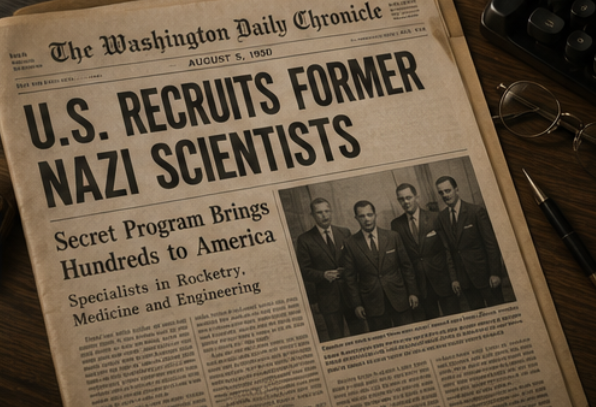
The scientific contributions of Operation Paperclip recruits to American military and civilian technology were genuinely extraordinary — and this is precisely what makes the program’s moral calculus so difficult to dismiss. The knowledge these men brought accelerated American capabilities in multiple domains by years or decades. The question that has never been fully answered is whether the same advances could have been achieved without importing men with war crime records, and whether the answer to that question would have changed the decision.
Ballistic missiles: The entire American intercontinental ballistic missile program of the 1950s was built on V-2 technology and German expertise. The Redstone missile — America’s first nuclear-capable ballistic missile — was designed by von Braun and his team and was a direct evolution of the V-2.
Chemical and biological weapons: German expertise in nerve agents — particularly Sarin and Tabun, which Germany had developed and stockpiled but never used — was incorporated directly into the American chemical weapons program. Kurt Blome and other biological warfare researchers contributed to the US Army Chemical Corps’ biological weapons program that ran until 1969.
Space medicine: Hubertus Strughold, who had overseen freezing and low-pressure experiments on Dachau prisoners that killed an unknown number of them, became the head of the USAF School of Aviation Medicine’s Department of Space Medicine and was celebrated as the “Father of Space Medicine.” Medical knowledge about human tolerances for altitude, temperature, and oxygen deprivation — knowledge gained from lethal experiments on concentration camp prisoners — fed directly into American research on keeping pilots and astronauts alive in extreme environments.
10. NASA and the Space Race: Operation Paperclip’s Most Celebrated Legacy
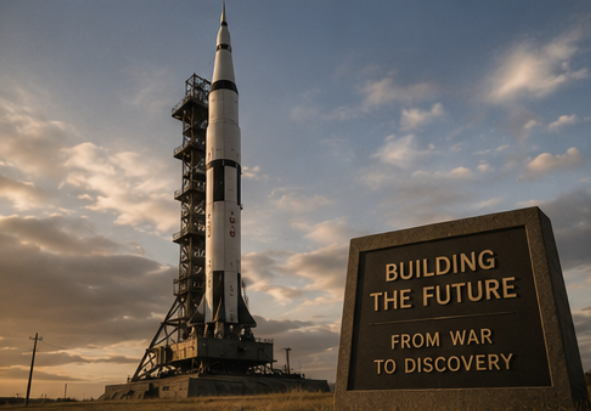
The Saturn V rocket — the most powerful rocket ever built, which carried Apollo astronauts to the Moon — was designed by Wernher von Braun and a team that included multiple Operation Paperclip veterans. The first director of Kennedy Space Center, Kurt Debus, was an SS member who had overseen V-2 launches in Nazi Germany. America’s greatest technological triumph was built in significant part by men whose previous work had been built on slave labor and war crimes. (NASA / Public Domain)
The most publicly visible legacy of Operation Paperclip is America’s space program. When President Kennedy committed America to reaching the Moon by the end of the 1960s, the program he set in motion was led at its technical core by men who had come to America under Operation Paperclip. Von Braun directed the development of the Saturn V — the rocket that made the Moon landing possible. Kurt Debus, an SS member and V-2 launch director, became the first director of the Kennedy Space Center in Florida. Arthur Rudolph, who had been the production director at the Mittelwerk factory where 12,000 prisoners died building V-2s, designed the production and management systems for the Saturn V program.
When Neil Armstrong stepped onto the Moon on July 20, 1969, and the world watched in awe, the rocket that put him there had been designed by an SS officer, the launch facility had been directed by an SS member, and the production systems had been designed by a man who had managed a factory where thousands of concentration camp prisoners had died. America’s proudest moment of the 20th century was built, in significant part, on the foundation of its darkest moral compromise.
11. The State Department’s Objections — and Why the Military Always Won
It is important to note that the Operation Paperclip program was not unopposed within the US government. The State Department raised objections consistently throughout the program’s existence, arguing that importing Nazi scientists violated both American law and the Nuremberg principles that America itself had established. Individual officials, including Samuel Klaus, wrote internal memos arguing that the program was morally indefensible and legally problematic.
These objections were overruled every time by the Joint Chiefs of Staff, who argued that the military imperative of the Cold War outweighed the moral and legal considerations. The pattern that emerged — in which military intelligence presented scientists’ falsified dossiers to the State Department and immigration authorities as fait accompli, leaving little room for meaningful review — became the standard operating procedure for the program.
The only case in which public pressure was strong enough to force a reversal was Walter Schreiber’s — and even then, the reversal took the form of quietly relocating him to Argentina rather than holding him accountable for his crimes. The institutional momentum of the Operation Paperclip Nazi scientists program was essentially unstoppable once it had begun, because the military framed it as a national security necessity and that framing consistently trumped every other consideration.
12. How Operation Paperclip Was Finally Exposed and Made Public
Operation Paperclip was not a complete secret at the time — it was known in broad outline to journalists and some members of Congress. What was not known was the full extent of the scientists’ Nazi records and the systematic falsification that had allowed them to enter the country. Occasional press exposés, like the Drew Pearson column on Walter Schreiber, created temporary furor and were then forgotten.
The fullest public reckoning came through the work of investigative journalists and historians in the 1980s and beyond, as Freedom of Information Act requests began to pry loose classified documents. The case of Arthur Rudolph — who had been the Saturn V production director — became a flashpoint in 1984, when the Justice Department’s Office of Special Investigations confronted him with evidence of his role at the Mittelwerk. Rudolph surrendered his American citizenship and left the country rather than face prosecution, moving to West Germany.
Annie Jacobsen’s 2014 book Operation Paperclip: The Secret Intelligence Program that Brought Nazi Scientists to America drew on thousands of newly declassified documents to provide the most comprehensive account of the program ever published. It documented in forensic detail the systematic falsification of records, the specific war crimes records of individual scientists, and the chain of authorization that ran from the Joint Chiefs of Staff to the Oval Office. The book became a bestseller and brought the history of Operation Paperclip to the widest audience it had ever reached.
“The records were not merely incomplete. They were deliberately falsified. This was not the work of rogue officers. This was institutional policy.”
— Annie Jacobsen, Operation Paperclip: The Secret Intelligence Program that Brought Nazi Scientists to America (Little, Brown, 2014)
13. The Soviet Version: Operation Osoaviakhim Did the Same Thing
One argument consistently made in partial defense of Operation Paperclip is that the alternative was allowing the Soviet Union to capture all the scientists instead. This argument has validity as far as it goes — the Soviet recruitment operation was real, large-scale, and in some respects even more aggressive than the American program.
Operation Osoaviakhim, conducted on October 22, 1946, was a single-night mass deportation of approximately 2,500 German scientists and technicians — along with their families and equipment — to the Soviet Union. Unlike the American program, which recruited scientists with varying degrees of voluntarism, Osoaviakhim was a forced deportation: families were woken in the night, given hours to pack, and transported east by train. The scientists worked in the Soviet weapons and space programs under effective captivity until most were repatriated to Germany in the early 1950s.
The Soviet space program — Sputnik, the first human in space, the early Soviet lead in the Space Race — was built with the same German expertise, taken by different methods. Both superpowers decided that winning the technological competition of the Cold War was worth protecting Nazi scientists from accountability. The moral failure of Operation Paperclip was not uniquely American. But it was American. And it was done in the name of a country that had just spent four years fighting a war against what those scientists represented.
14. The Moral Cost: What America Traded Away with Operation Paperclip
The moral cost of Operation Paperclip Nazi scientists recruitment was not abstract. It had specific, measurable consequences for specific people.
The survivors of the Dora-Mittelbau concentration camp — men who had survived building V-2 rockets under conditions designed to kill them — watched the engineers who had visited their factory become celebrated American heroes. The survivors of Ravensbrück medical experiments — women whose bodies had been deliberately infected and mutilated — watched the doctors who oversaw those experiments receive American military positions. The families of the 9,000 people killed by V-2 rockets in Britain and Belgium watched the men who designed those rockets receive American medals.
America had prosecuted Nazi doctors at Nuremberg. America had helped establish the principle, codified in the Nuremberg Code, that human experimentation without consent is a crime against humanity. America had helped write the legal framework that was supposed to hold the architects of these crimes accountable. Then America hired them.
The Saturn V was magnificent. The Moon landing was genuinely one of humanity’s greatest achievements. None of that makes what was done to enable it acceptable. Both things can be true simultaneously — and acknowledging both is the only honest way to engage with this history.
15. Frequently Asked Questions About Operation Paperclip
❓ What was Operation Paperclip and when did it happen?
Operation Paperclip was a secret United States government program that recruited over 1,600 German scientists, engineers, and technicians from Nazi Germany after World War II and brought them to work in American military and civilian scientific programs. The program ran from 1945 to 1959 and was operated by the Joint Intelligence Objectives Agency under the authority of the Joint Chiefs of Staff. Many of the recruited scientists were Nazi Party members, SS officers, or men with documented involvement in war crimes including slave labor and human experimentation. Their records were systematically falsified to allow entry into the United States in violation of immigration laws and President Truman’s own directive prohibiting the recruitment of active Nazis.
❓ Was Wernher von Braun a Nazi war criminal?
Wernher von Braun was a Nazi Party member from 1937 and an SS officer who rose to the rank of Sturmbannführer (major). He was the technical director of the V-2 rocket program at Peenemünde and visited the Mittelwerk underground factory where V-2 rockets were produced by concentration camp prisoners from Dora-Mittelbau. An estimated 12,000 prisoners died building V-2 rockets at Mittelwerk — more than the approximately 9,000 people killed by V-2s in combat. Whether von Braun should be classified as a war criminal in the strict legal sense has been debated by historians. What is not debated is that he was an SS officer who benefited from and continued a slave labor program while thousands of people died around it, and that these facts were suppressed in his Operation Paperclip dossier.
❓ Did President Truman know about Operation Paperclip?
President Truman approved the program in 1945 with an explicit condition: no one who had been more than a nominal Nazi Party member or an active supporter of Nazi militarism should be recruited. This condition was then systematically circumvented by the military officers running the program, who falsified dossiers to conceal Nazi records and war crimes involvement. Whether Truman knew that his conditions were being violated is unclear. What is documented is that the falsification was institutional, systematic, and conducted with the knowledge and approval of the Joint Chiefs of Staff — meaning it went to the highest levels of the military chain of command. The State Department’s objections, which implied that Truman’s conditions were being violated, were consistently overruled by the military.
❓ How did Operation Paperclip affect America’s space program?
Operation Paperclip had a profound and direct impact on America’s space program. Wernher von Braun became the director of NASA’s Marshall Space Flight Center and the chief architect of the Saturn V rocket that carried Apollo astronauts to the Moon. Kurt Debus, an SS member who had directed V-2 launches in Germany, became the first director of Kennedy Space Center. Arthur Rudolph, who had been the production director at the Mittelwerk factory where 12,000 prisoners died, designed the production and management systems for the Saturn V program. Without the expertise brought by Operation Paperclip recruits, the American space program would have proceeded more slowly and the Moon landing in 1969 might not have happened when it did.
❓ Was anyone from Operation Paperclip ever prosecuted for war crimes?
No Operation Paperclip scientist was ever prosecuted for war crimes in the United States. The most significant accountability action was taken against Arthur Rudolph in 1984, when the Justice Department’s Office of Special Investigations confronted him with evidence of his role at the Mittelwerk factory. Rather than face prosecution, Rudolph surrendered his US citizenship and moved to West Germany. West German courts later declined to prosecute him. Walter Schreiber, whose Ravensbrück experiments were publicly exposed in 1952, was quietly relocated to Argentina. Most Operation Paperclip scientists lived out their lives in the United States, receiving awards and honors, without ever facing formal accountability for their wartime activities.
❓ Where can I learn more about Operation Paperclip?
Annie Jacobsen’s Operation Paperclip: The Secret Intelligence Program that Brought Nazi Scientists to America (Little, Brown, 2014) is the definitive account and is based on thousands of declassified government documents. Linda Hunt’s Secret Agenda: The United States Government, Nazi Scientists, and Project Paperclip (1991) was the first comprehensive journalistic investigation. Clarence Lasby’s Project Paperclip: German Scientists and the Cold War (1971) is the earliest serious academic treatment. Tom Bower’s The Paperclip Conspiracy (1987) provides additional detail on the British parallel program. The National Archives in College Park, Maryland holds the largest collection of declassified Operation Paperclip documents and is accessible to researchers.
▪ RELATED DARK HISTORY ARTICLES
→ Project MKUltra: The CIA’s Secret Mind Control Program (1953–1973)
→ Unit 731: Japan’s Secret Biological Warfare Program in China
→ The Tuskegee Syphilis Study: 40 Years of Deliberate Medical Neglect
→ King Leopold II’s Congo Free State: The Forgotten Genocide
→ The Tulsa Race Massacre: America’s Buried Black Wall Street (1921)
▤ SOURCES & FURTHER READING
▸ Annie Jacobsen — Operation Paperclip: The Secret Intelligence Program that Brought Nazi Scientists to America (Little, Brown, 2014)
▸ Linda Hunt — Secret Agenda: The United States Government, Nazi Scientists, and Project Paperclip (St. Martin’s, 1991)
▸ Tom Bower — The Paperclip Conspiracy (Little, Brown, 1987)
▸ Clarence Lasby — Project Paperclip: German Scientists and the Cold War (Atheneum, 1971)
▸ US National Archives — Operation Paperclip Declassified Records — archives.gov
▸ Nuremberg Doctors’ Trial Records — United States Holocaust Memorial Museum — ushmm.org